Table of Contents
If you have priced out chatbots, you already know the problem. Every vendor site says “contact sales” or throws out a number that means nothing without context. If you are wondering how much does an AI chatbot cost, let’s fix that here with real ranges you can actually use.
Short answer first. A basic ai chatbot runs free to about 50 dollars a month on a small tool like tidio. A small business chatbot with real automation usually lands somewhere between 100 per month and 500 per month depending on volume and the platform. A custom chatbot built around your own systems can run anywhere from a couple thousand dollars up front to five figures, plus a monthly fee for hosting and upkeep. That’s the whole range. Now let’s break down why the number moves around so much.
Chatbot Pricing Models Explained
Here’s the thing most people miss when they start shopping. Chatbot pricing is not one thing. It’s four or five different models stacked together, and vendors mix them depending on what they’re selling.
Free Plan and Free Tier Options
A free tier gets you a bot with limited conversations a month, basic natural language handling, and usually a “powered by” badge on your widget. Tidio for example gives you a free plan that covers a small volume of chats, which is fine if you’re testing the water. For a lot of small businesses this is where they start, and honestly it’s a reasonable way to see if a chatbot even fits how customers reach out.
Monthly Subscription and Per Seat Pricing
Once you outgrow the free plan you’re looking at a monthly subscription, usually tiered by how many conversations or contacts you handle. Some platforms still charge per seat pricing, meaning you pay per human agent who has access to the dashboard, rather than per seat being tied to the bot itself. That model is fading though. More platforms now charge based on usage instead of headcount.
Usage Based Pricing
This is where things get interesting and also where people get surprised by their bill. Usage based pricing charges you per resolution or per conversation, not a flat rate. Some tools charge around 6 per resolved conversation once you’re past your included quota. If your chatbot handles a thousand resolutions a month that adds up fast, so pay attention to what counts as a “resolution” before you sign anything.
Enterprise Plan and Enterprise Pricing
An enterprise plan is built for high volume and comes with custom integration work, dedicated support, and its own pricing structure that’s usually negotiated directly. Enterprise pricing rarely shows up on a public pricing page because it depends on your specific use case, your existing systems, and how much custom ai work is needed to connect everything.
Chatbot Cost Per Month: Real Numbers
Let’s put actual figures next to these plans so you’re not guessing.
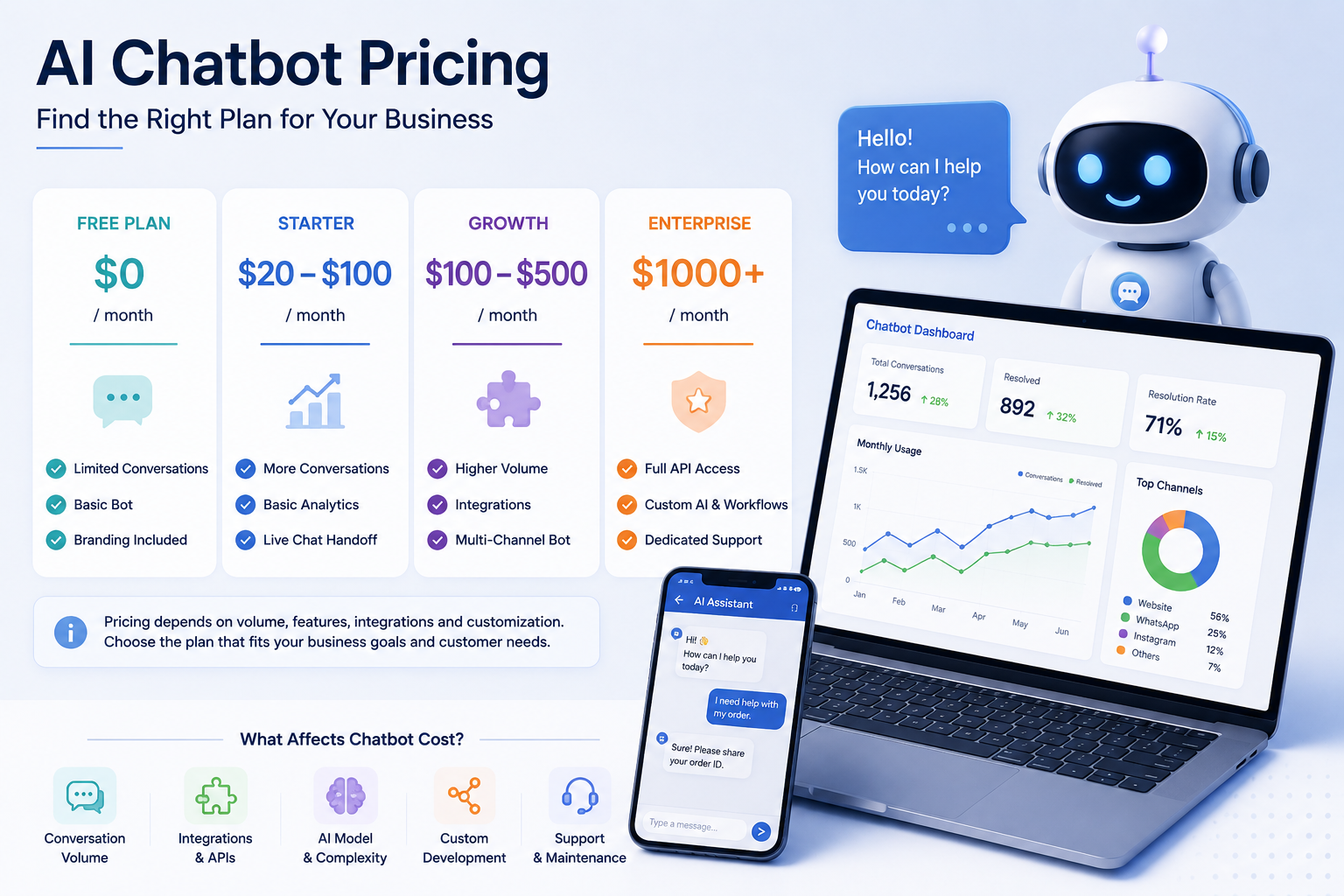
| Tier | Typical Monthly Cost | What You Get |
|---|---|---|
| Free plan | 0 | Limited chats, basic bot, branding included |
| Starter | 20 to 100 per month | More conversations, basic analytics, live chat handoff |
| Growth | 100 to 500 per month | Higher volume, integrations, multi channel bot |
| Enterprise | Custom, often 1000+ | Full api access, custom ai, dedicated support |
For small businesses the sweet spot tends to sit around 100 per month, sometimes stretching toward 500 per month once you add WhatsApp or Instagram channels on top of a website widget. That’s roughly what we see when we scope chatbot projects for clients running lead capture across multiple channels,which is part of what our AI chatbot for business work covers.
Custom Chatbot Development Cost

A template bot from a pricing page is one thing. A chatbot built to actually talk to your booking system, your CRM, and your inventory is a different project entirely, and the development cost reflects that.
Custom chatbot development cost depends mostly on integration work. Connecting a bot to your existing systems, whether that’s a booking calendar, a payment processor, or an internal database, takes real engineering time. A simple custom build with one or two integrations might start around 1500 to 3000 dollars. Something more involved, with multiple api connections and custom logic, can run 8000 dollars or more before you even get to monthly hosting.
Ongoing maintenance is the part people forget to budget for. Your ai model gets updated, your integrations shift when a connected platform changes its api, and someone needs to watch the analytics to see where the bot is actually failing conversations. Skip this and your custom chatbot quietly gets worse over six months without anyone noticing until customers complain.
GPT Chatbot Cost and Generative AI Pricing
Gpt chatbot cost works differently from a standard rule based bot, and this trips people up constantly.
A generative ai chatbot built on something like chatgpt or another large language model charges based on tokens, which roughly means how much text goes in and comes out per conversation. This falls under conversational ai rather than the older scripted bot model. For a moderate volume small business, the ai credit usage might cost anywhere from 20 to 200 dollars a month just for the model calls, separate from whatever platform fee you’re paying to host the chatbot interface itself.
The upside is real though. Generative ai chatbots handle messy, natural language questions way better than old school scripted bots. A customer typing “can I switch my delivery to Thursday instead” gets understood without you having to program that exact phrase. That’s the tradeoff. Better conversations, less predictable monthly ai model cost.
AI Chatbot Pricing By Platform
Not every ai platform prices the same way, and picking the wrong one for your use case wastes money either through overpaying for features you don’t use or hitting usage caps constantly.
Some chatbot platforms lean toward small businesses with flat tier pricing and simple setup, tidio being one of the more common entry points here. Others are built for enterprise ai solutions with custom contracts and dedicated account teams. A handful sit in the middle, offering ai powered automation with decent api access at a mid range subscription, which is usually the right fit if you’re past the free tier but not ready for a fully custom build.
If you’re running outreach on LinkedIn alongside a chatbot, it’s worth knowing platform choice affects how well the two connect. We’ve seen this come up a lot when clients pair a website bot with our LinkedIn automation service for B2B lead flow, since the chatbot and the outreach sequence need to hand off leads cleanly.
What Affects Total Cost of an AI Chatbot
Total cost isn’t just the subscription line on your invoice. A few things move the number more than people expect.
Your use case matters first. A restaurant bot answering “are you open Sunday” is cheap to run. A logistics bot tracking driver status and dispatch updates in real time needs more processing and costs more. Chatbot usage volume is the second big factor, since most pricing scales with conversations or resolutions, so a slow month costs less and a busy month costs more, which is honestly how it should work.
Human agents still factor in too. Most setups keep a live chat handoff for anything the bot can’t handle, and that handoff either needs staff time or a separate live chat tool, both of which add to what you’re really spending each month. Analytics access sometimes sits behind a higher tier as well, and skipping it is a mistake because you lose visibility into where conversations are actually breaking down.
Ai deployments across multiple channels, say WhatsApp plus website plus Instagram, usually cost more than a single channel bot, but they also capture more leads. If WhatsApp is your main channel, this is exactly the kind of setup our WhatsApp automation service is built around, handling lead qualification and appointment booking through the channel your customers already use.
Chatbot ROI: Is It Worth The Cost
Cost savings is the number most owners actually care about, more than the sticker price of the tool itself.
A decent ai customer service setup can resolve a big share of repetitive questions without a human touching them, freeing staff for the conversations that actually need a person. Ai resolutions on simple questions like hours, pricing, or order status cost a fraction of what a human agent costs per interaction. That’s the real cost comparison worth making, not just the monthly subscription against your old budget.
Chatbot roi is strongest for businesses handling repeat, predictable questions at volume. It’s weaker if your conversations are mostly complex or emotionally sensitive, where customers genuinely want a person and get frustrated hitting a bot first. Being honest about that upfront saves you from buying a tool that annoys your customers instead of helping them.For businesses managing high inbound inquiry volume like real estate or ecommerce, a bot handling first response before qualification tends to pay for itself fastest, similar to how our real estate automation work is scoped around instant enquiry response.
How Think AI Works Solves the Lead Follow-Up Problem
Most businesses that come to us aren’t missing leads. They’re missing the system that catches them. A lead comes in through a form, an ad, or a WhatsApp message, and it sits in an inbox until someone has a free minute. By then the moment’s gone.
We build the automated lead follow-up system around wherever your leads actually come from, not just one channel. That means the trigger fires the second a lead enters your CRM, whether that lead started on a landing page, a Meta ad, or a WhatsApp conversation.
Instant Response Without Adding Headcount
You don’t need a bigger sales team to follow up faster. You need the first message to go out automatically, then a person to step in once someone actually replies. That’s the balance we build every workflow around.
One Pipeline, Every Lead Source Connected
If leads come in through five different channels and land in five different places, half of them get missed by default. We pull every source into one pipeline through our GoHighLevel automation setup, so nothing depends on someone remembering to check a second inbox.
Follow-Up That Adapts to Each Lead
Not every lead should get the same sequence. A warm lead ready to book and a cold one that just downloaded a guide need different messages at different speeds. We build the logic so the system tells the difference, using lead scoring to decide who gets a fast direct offer and who goes into a longer nurture track.
Why Choose Think AI Works for Lead Follow-Up Automation
Plenty of agencies will set up a follow-up email and call it automation. We build the full loop, capture, trigger, sequence, and handoff, so nothing depends on a person remembering a step.
What we bring that’s harder to copy is the combination. We’re not just a CRM reseller and we’re not just a chatbot shop. We connect lead capture, WhatsApp and email follow-up, AI-assisted scoring, and CRM workflows into one system, which means fewer handoffs between tools and fewer places for a lead to get lost.
We also don’t hand you a finished automation and disappear. Sequences get reviewed and adjusted based on what’s actually converting, not left running on autopilot from day one. That ongoing part is where most DIY setups fall behind, since a sequence built once in January rarely still fits how leads behave by summer.
Benefits of Working With Think AI Works
The real value isn’t the automation itself, it’s what stops happening once it’s running.
- Leads stop sitting unanswered overnight or over a weekend, since the first message goes out the moment they come in.
- Your sales team spends time on leads that are actually engaged instead of working through a list in order.
- Follow-up stays consistent even during busy weeks, so nothing slips just because someone was slammed with other work.
- Reporting shows which messages in the sequence are actually landing, so the follow-up system gets better over time instead of staying static.
- You get one pipeline instead of leads scattered across email, WhatsApp, and ad platform inboxes.
Each of these ties back to the same problem this article opened with. A lead that goes cold overnight isn’t a sales problem, it’s a system problem, and that’s the part we’re built to fix.
Case Study: Fixing a Broken Follow-Up Process
The problem. A client running lead generation through Meta ads and a website form was losing a noticeable share of leads simply because responses depended on whoever was free that day. Leads that came in after hours or over the weekend often didn’t get a reply until the following business day, by which point several had already gone with a competitor.
The approach. We mapped every point a lead could enter the business, the ad form, the website, and WhatsApp enquiries, into a single CRM pipeline. From there we built an automated follow-up sequence that fired an instant confirmation message, followed by a short value message within a day, and a direct offer if there was still no reply after that.
The solution. Lead scoring was added so replies showing real intent got routed straight to the sales team, while lower intent leads moved into a longer nurture sequence instead of getting dropped entirely. Nothing sat waiting on a person to notice it.
Let’s take the busywork off your plate.
Book a free 30-minute call and we’ll map out exactly where automation can save you hours every week — no pressure, no jargon.
Frequently Asked Questions
u003cstrongu003eHow much does an ai chatbot cost per month?u003c/strongu003e
Most small businesses land somewhere between 100 per month and 500 per month once they move past a free plan, depending on channels and volume.
u003cstrongu003eIs there a free ai chatbot option?u003c/strongu003e
Yes. Tools like tidio offer a free tier with limited conversations, which works fine for testing before you commit to a paid plan.
u003cstrongu003eWhat does an ai chatbot typically cost for a small business?u003c/strongu003e
Small businesses usually cost around 100 to 300 per month for a mid tier plan covering one or two channels with basic analytics.
u003cstrongu003eHow much does custom chatbot development cost?u003c/strongu003e
A simple custom build starts around 1500 to 3000 dollars, while more complex integration work can run 8000 dollars or higher.
u003cstrongu003eWhat does gpt chatbot cost compare to a regular bot?u003c/strongu003e
A gpt based chatbot adds token costs on top of the platform fee, often 20 to 200 dollars a month depending on conversation volume, but handles natural language questions far better.
u003cstrongu003eDo chatbots charge per resolution or per conversation?u003c/strongu003e
Both models exist. Usage based pricing often charges per resolution, sometimes around 6 dollars per resolved chat past your included quota, while others charge flat per conversation.
u003cstrongu003eWhat is included in enterprise chatbot pricing?u003c/strongu003e
Enterprise plans typically include custom integration, dedicated support, higher volume limits, and pricing negotiated directly rather than listed publicly.
u003cstrongu003eIs tidio free or paid?u003c/strongu003e
Tidio offers both. A free plan for lower volume use and paid tiers that scale up with more conversations and features.
u003cstrongu003eHow much does a chatbot cost to maintain over time?u003c/strongu003e
Ongoing maintenance can add 10 to 20 percent of your original build cost per year, covering ai model updates and integration fixes.
u003cstrongu003eWhat is the real cost of a chatbot beyond the subscription?u003c/strongu003e
Factor in live chat handoff staffing, analytics review time, and periodic updates as your existing systems change.
u003cstrongu003eDoes chatbot pricing depend on usage volume?u003c/strongu003e
Yes, most pricing structures scale with conversations or resolutions, so cost rises and falls with how busy your bot actually is.
u003cstrongu003eWhat is the roi on an ai chatbot?u003c/strongu003e
Roi is strongest for high volume repetitive questions, where the bot saves human agent time. It’s weaker for complex or sensitive conversations.
u003cstrongu003eHow much do enterprise ai solutions typically cost?u003c/strongu003e
Enterprise ai solutions often start in the low thousands per month and scale based on integration complexity and support needs, though exact numbers depend on your provider and use case.