Table of Contents
If you’re wondering how much does AI automation cost and why quotes range anywhere between $200 a month and $60,000 for what sounds like a similar project, you’re not losing your mind. AI automation pricing is genuinely all over the map, and most of that gap comes down to scope, not sales tactics. A basic WhatsApp chatbot that answers FAQs costs a fraction of what a full lead qualification and booking system costs, even though both get called “automation” in a sales call.
Here’s what actually drives ai automation cost in 2026, what an ai automation agency typically charges by project type, and how to tell when a quote is fair versus padded. We’ve built and priced automation projects across ecommerce, real estate, and restaurants, so this isn’t theory. It’s what we see on real invoices.
If you’re weighing whether to hire an ai automation agency or figure this out yourself, this article gives you the numbers to do that math.
What Determines AI Automation Cost? (Key Cost Drivers)
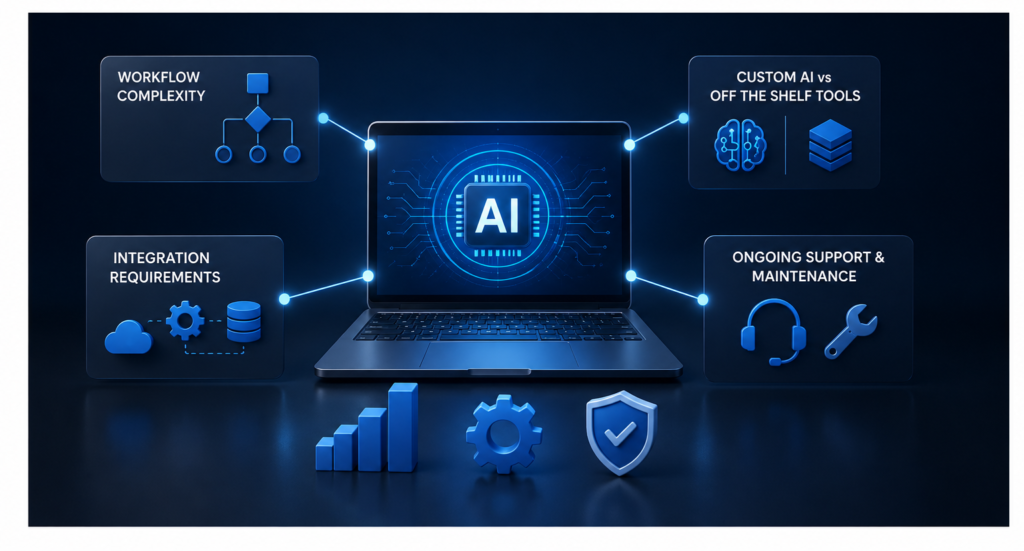
AI automation cost mainly comes down to four things: how complex the workflow is, how many systems it needs to talk to, whether you need a custom AI build or an off the shelf tool, and how much ongoing support the system needs after launch.
Workflow complexity and scope. A single-step automation, like sending an automatic reply when someone messages your Instagram, is cheap. A multi-step workflow that qualifies a lead, checks a calendar, books a slot, and updates your CRM is a different animal entirely, and it should cost more. The more decision points a workflow has, the more testing it needs before it’s reliable.
Integration requirements. Connecting to a CRM, a booking system, or a payment API adds real hours. Some platforms have clean APIs. Others are a mess, and that mess becomes your bill. If your existing software is old or poorly documented, expect integration to eat up more of the budget than the automation logic itself.
Custom AI vs off the shelf tools. You can spin up a basic chatbot on a no-code platform for very little. A custom AI system trained on your specific product catalog, tone, and edge cases costs more because someone has to build and test that logic by hand.
Ongoing support and maintenance. This is the part people forget to budget for. APIs change. Models get updated. Workflows break when a third-party tool changes its interface without warning. Ongoing support is usually where the real total cost lives, not the initial build.
AI Automation Pricing Models Explained (AI Agency Pricing Models)
Most ai agency pricing models fall into four buckets: hourly, project based, monthly subscription, and per task.
| Pricing Model | Typical Range | Best For |
|---|---|---|
| Hourly rates | $50–$200/hour | Small fixes, consulting, custom scripts |
| Project based / upfront | $500–$50,000+ | Defined builds with a clear scope |
| Monthly subscription / retainer | $100–$5,000/month | Ongoing management, chatbots, workflow upkeep |
| Per task or per run | $0.01–$5 per task | High volume, usage based automations |
Hourly rates work when the job is small or undefined, like fixing a broken workflow or adding one new automation step. You pay for time, plain and simple, and it can get expensive fast if the scope creeps.
Project based pricing is common for full builds. You agree on a scope, get a fixed price upfront, and the agency delivers against that scope. This protects you from surprise bills but only if the scope document is detailed. A vague scope is where project based pricing goes wrong for both sides.
Monthly subscription and retainer models cover ongoing management, small tweaks, and support. A lot of chatbot and CRM automation setups run this way because the system needs regular attention, not a one time build.
Per task or per run pricing shows up more with high volume systems, like an AI voice agent handling hundreds of calls a day. You pay per call or per completed task instead of a flat monthly fee, which can be cheaper or more expensive depending on your volume.
AI Automation Cost Breakdown by Project Type (Pricing Breakdown)
Here’s roughly what businesses pay by project tier in 2026, based on typical scopes we see in the market.
| Project Type | Price Range | Typical Timeline |
|---|---|---|
| Basic automation (single chatbot, simple workflow) | $100–$1,000 | 1–2 weeks |
| Mid level automation (CRM + workflow integration) | $1,000–$10,000 | 3–8 weeks |
| Enterprise / custom AI system | $10,000–$100,000+ | 2–6 months |
| AI voice agent | $300–$3,000/month plus per minute usage | 2–4 weeks |
Basic automation covers things like a simple chatbot that answers common questions or a workflow that sends a WhatsApp confirmation after a form submission. This typically costs less because there’s little custom logic involved.
Mid level automation is where most small and mid size businesses land. Think lead qualification bots connected to a CRM, automated appointment booking, or abandoned cart recovery flows for an online store. This tier usually includes some custom AI configuration and at least one system integration.
Enterprise or custom AI systems involve multiple integrations, custom trained AI models, and workflows across departments. This is where ai automation agency cost climbs fastest, and honestly, it should. You’re paying for architecture, testing, and a system built to handle edge cases a template can’t.
AI agent costs, whether it’s a chatbot, voice agent, or outreach agent, usually split into a setup fee plus a monthly cost tied to usage. An ai voice agent handling inbound calls, for example, might run $500 a month as a base plus a small per minute charge once call volume passes a threshold.
If you’re looking at a specific use case like AI chatbot for business across WhatsApp, your website, or Instagram, pricing usually lands in the mid level tier since it involves lead capture logic and at least one integration.
AI Automation Agency Pricing vs In House / Freelance
The short answer: agencies cost more upfront but usually cost less over a year once you factor in salary, benefits, and the learning curve of building this in house.
Agency model. You typically pay a setup fee plus a monthly retainer. This covers the build, testing, and ongoing fixes. Agencies also bring pattern recognition. They’ve already hit the weird edge cases your industry throws up, so you’re not paying to discover those the hard way.
Freelancer hourly rates. Freelancers can be cheaper per hour, often $30–$100, but total cost depends heavily on how experienced they are with your specific tools. A freelancer new to your CRM might take three times as long as one who’s built fifty integrations with it.
In house hiring. Hiring a full time automation specialist means a loaded cost of salary plus benefits plus training time, often $60,000–$120,000 a year depending on your market. That only makes sense if you have enough ongoing automation work to keep someone busy full time. For most small and mid size businesses, that math doesn’t work out until you’re running a genuinely large number of workflows.
If you’re deciding between models for something like GoHighLevel automation, agencies that specialize in that platform usually move faster than a generalist freelancer figuring it out for the first time.
Hidden and Indirect Costs of AI Automation (Direct and Indirect Costs)
The quoted price is rarely the total cost. Here’s what tends to get missed.
Setup and onboarding costs. Some agencies charge separately for account setup, API access requests, or migrating existing data into the new system. Ask upfront whether this is bundled or billed extra.
Third party software and API fees. Your automation might run great, but if it depends on a paid API (for messaging, calendar sync, or AI model calls), that’s a separate monthly cost the agency doesn’t control and usually doesn’t include in their quote.
Training and change management. Your team needs to actually use the new system. That means time spent learning it, and sometimes resistance to change that slows adoption. This is a real cost even though it never shows up on an invoice.
Between setup, third party fees, and the time your team spends adjusting, direct and indirect costs can add another 15 to 30 percent on top of the sticker price. Budget for that instead of getting surprised by it.
AI Automation ROI: Is It Worth the Cost? (Automation ROI)
Automation roi usually shows up within three to six months when the workflow replaces a task someone was doing manually, and it’s calculated by comparing time and cost saved against total setup and running cost.
How to calculate automation ROI. Take the hours saved per month, multiply by the hourly cost of the person who used to do that task, then subtract your monthly automation cost. If a lead qualification bot saves 40 hours a month at $25 an hour, that’s $1,000 in saved labor. If the bot costs $300 a month to run, you’re netting $700 a month, or roughly $8,400 a year, against a system that might have cost $3,000 to build.
According to McKinsey’s 2025 State of AI research, most organizations using AI report use case level cost and revenue gains, though enterprise wide financial impact still lags behind adoption. That gap matters here too. A single well scoped automation tends to show clear ROI fast. A messy, overbuilt system with no clear task to replace often doesn’t, no matter how much it costs.
Real examples by industry. In ecommerce, abandoned cart recovery bots typically recover 5 to 15 percent of otherwise lost sales, often paying for themselves within the first month. In real estate, instant enquiry response and lead qualification can cut response time from hours to seconds, which directly affects conversion since the first agent to respond usually wins the lead. In logistics, dispatch automation and driver performance scoring cut the manual coordination time that used to eat up a dispatcher’s whole morning.
For an example closer to property businesses, AI automation for real estate setups that handle enquiry response and viewing bookings tend to show ROI the fastest, since speed to lead is such a direct revenue driver.
How Think AI Works Solves the Lead Follow-Up Problem
Most businesses that come to us aren’t missing leads. They’re missing the system that catches them. A lead comes in through a form, an ad, or a WhatsApp message, and it sits in an inbox until someone has a free minute. By then the moment’s gone.
We build the automated lead follow-up system around wherever your leads actually come from, not just one channel. That means the trigger fires the second a lead enters your CRM, whether that lead started on a landing page, a Meta ad, or a WhatsApp conversation.
Instant Response Without Adding Headcount
You don’t need a bigger sales team to follow up faster. You need the first message to go out automatically, then a person to step in once someone actually replies. That’s the balance we build every workflow around.
One Pipeline, Every Lead Source Connected
If leads come in through five different channels and land in five different places, half of them get missed by default. We pull every source into one pipeline through our GoHighLevel automation setup, so nothing depends on someone remembering to check a second inbox.
Follow-Up That Adapts to Each Lead
Not every lead should get the same sequence. A warm lead ready to book and a cold one that just downloaded a guide need different messages at different speeds. We build the logic so the system tells the difference, using lead scoring to decide who gets a fast direct offer and who goes into a longer nurture track.
Why Choose Think AI Works for Lead Follow-Up Automation
Plenty of agencies will set up a follow-up email and call it automation. We build the full loop, capture, trigger, sequence, and handoff, so nothing depends on a person remembering a step.
What we bring that’s harder to copy is the combination. We’re not just a CRM reseller and we’re not just a chatbot shop. We connect lead capture, WhatsApp and email follow-up, AI-assisted scoring, and CRM workflows into one system, which means fewer handoffs between tools and fewer places for a lead to get lost.
We also don’t hand you a finished automation and disappear. Sequences get reviewed and adjusted based on what’s actually converting, not left running on autopilot from day one. That ongoing part is where most DIY setups fall behind, since a sequence built once in January rarely still fits how leads behave by summer.
Benefits of Working With Think AI Works
The real value isn’t the automation itself, it’s what stops happening once it’s running.
- Leads stop sitting unanswered overnight or over a weekend, since the first message goes out the moment they come in.
- Your sales team spends time on leads that are actually engaged instead of working through a list in order.
- Follow-up stays consistent even during busy weeks, so nothing slips just because someone was slammed with other work.
- Reporting shows which messages in the sequence are actually landing, so the follow-up system gets better over time instead of staying static.
- You get one pipeline instead of leads scattered across email, WhatsApp, and ad platform inboxes.
Each of these ties back to the same problem this article opened with. A lead that goes cold overnight isn’t a sales problem, it’s a system problem, and that’s the part we’re built to fix.
Case Study: Fixing a Broken Follow-Up Process
The problem. A client running lead generation through Meta ads and a website form was losing a noticeable share of leads simply because responses depended on whoever was free that day. Leads that came in after hours or over the weekend often didn’t get a reply until the following business day, by which point several had already gone with a competitor.
The approach. We mapped every point a lead could enter the business, the ad form, the website, and WhatsApp enquiries, into a single CRM pipeline. From there we built an automated follow-up sequence that fired an instant confirmation message, followed by a short value message within a day, and a direct offer if there was still no reply after that.
The solution. Lead scoring was added so replies showing real intent got routed straight to the sales team, while lower intent leads moved into a longer nurture sequence instead of getting dropped entirely. Nothing sat waiting on a person to notice it.
Let’s take the busywork off your plate.
Book a free 30-minute call and we’ll map out exactly where automation can save you hours every week — no pressure, no jargon.
How to Choose an AI Automation Agency Without Overpaying
Pick an agency that gives you a written scope, a clear pricing model, and examples of similar builds, not just a demo of what’s technically possible.
Questions to ask before you sign. Ask what’s included in the setup fee versus the monthly cost. Ask who owns the system if you ever want to switch agencies. Ask how they handle bugs after launch, and whether that’s covered or billed separately.
Red flags in agency pricing. Watch for vague scopes with no defined deliverables, quotes that seem too low for the complexity you’ve described, or contracts that lock you into a long retainer with no clear exit. If an agency can’t explain why something costs what it costs, that’s worth pausing on.
Why a clear pricing model matters. We price projects based on actual scope and industry, not a flat rate that ignores what your business needs. Whether you’re looking at AI lead generation through Meta ads and cold outreach, or something more contained like a WhatsApp booking bot for a restaurant, the price should reflect the actual work, not a generic package. If you want a number specific to your setup, get in touch and we’ll walk through it with you directly.
FAQs About how much does ai automation cost
u003cstrongu003eHow much does AI automation cost for a small business?u003c/strongu003e
Most small businesses spend between $500 and $5,000 on initial setup, plus $100 to $1,000 a month for ongoing support, depending on how many workflows they automate.
u003cstrongu003eWhat is the average AI automation agency pricing in 2026?u003c/strongu003e
Agency pricing typically ranges from $1,000 to $10,000 for mid level projects, with enterprise builds going well past $10,000. Monthly retainers usually land between $300 and $2,000.
u003cstrongu003eIs AI automation a one time cost or a monthly subscription?u003c/strongu003e
It’s usually both. You pay an upfront or project based fee for the build, then a monthly subscription or retainer for hosting, support, and any AI model usage costs.
u003cstrongu003eHow much does a custom AI chatbot cost?u003c/strongu003e
A basic chatbot can cost as little as $100 to $500 to set up. A custom chatbot trained on your specific business, with CRM integration, usually runs $1,000 to $5,000 plus a monthly fee.
u003cstrongu003eWhat’s included in an AI automation agency’s setup fees?u003c/strongu003e
Setup fees typically cover initial configuration, workflow design, testing, and connecting to your existing tools. Some agencies bundle onboarding and training into this fee, others charge separately, so ask directly.
u003cstrongu003eHow much does an AI voice agent cost per month?u003c/strongu003e
Most AI voice agents cost $300 to $3,000 a month as a base fee, plus a per minute charge once call volume passes a set threshold. Cost scales with call volume more than with complexity.
u003cstrongu003eDo AI automation agencies charge hourly or per project?u003c/strongu003e
Both, depending on the work. Small fixes and consulting are usually hourly. Full builds are usually project based with a fixed price agreed upfront.
u003cstrongu003eWhat affects AI automation cost the most?u003c/strongu003e
Integration complexity affects cost more than almost anything else. A workflow that only needs one connection is cheap. One that needs to sync across five different tools gets expensive fast, regardless of how simple the automation logic itself is.
u003cstrongu003eHow long until AI automation pays for itself?u003c/strongu003e
Most well scoped automations show positive ROI within three to six months, especially when they replace a clearly defined manual task like lead follow up or order confirmations.
u003cstrongu003eIs it cheaper to hire an AI agency or build in house?u003c/strongu003e
For most small and mid size businesses, an agency is cheaper over the first year once you account for salary, benefits, and training time an in house hire would need. In house only makes financial sense once you have enough ongoing automation work to justify a full time role.
u003cstrongu003eHow much does workflow automation cost for CRM integration?u003c/strongu003e
CRM integration alone typically adds $500 to $3,000 to a project, depending on how clean the CRM’s API is and how many fields and triggers need to sync.
u003cstrongu003eWhat hidden costs should I expect with AI automation projects?u003c/strongu003e
Expect third party API fees, possible data migration costs, and time spent training your team to use the new system. These can add 15 to 30 percent on top of the quoted price if they’re not clarified upfront.