Table of Contents
When comparing ai agents vs chatbots, two businesses both tell me they built a bot last year. One of them gets a fixed reply to “what are your hours” and nothing else. The other books appointments, checks a calendar, follows up if someone goes quiet, and hands off to a person only when it actually needs to. Same word, completely different tool, and that gap is exactly what trips people up.
By the end of this you will know the real difference between an ai agent and a chatbot, when each one actually makes sense for a business and how to tell which one you are looking at the next time a vendor pitches you either. We build both kinds of systems through our ai chatbot for business work, so this isn’t theory, it’s what we see break and what actually holds up.
What Is an AI Agent? (Quick Definition)
Core Concept: Goal-Oriented Action
An ai agent is software that can look at a situation, decide what to do about it and take action toward a goal, often across several steps without someone approving each one. That’s the plain version. It’s built to be agentic, meaning it acts with some independence instead of waiting for a fixed instruction every single time.
Autonomous Reasoning and Agentic AI
This is what people mean when they say agentic ai. The ai systems behind it are not just answering a question, they’re working through a small plan and adjusting as new information comes in. Ai agents have become genuinely more capable in the last couple of years, mostly because the models underneath them got better at reasoning autonomously instead of just predicting the next likely sentence.
Multi-Step Execution and Safeguards
Advanced ai like this can check a calendar, send a message, wait for a reply, then decide the next move based on what actually came back. That’s a different animal than a bot that just fires a canned response. Sophisticated ai setups like this take real engineering to get right and honestly plenty of agent projects fail simply because nobody set clear limits on what the thing was allowed to decide on its own.
What Is a Chatbot? (Quick Definition)
A chatbot is software built to hold a conversation using a fixed set of rules or a script, usually answering from a predefined list of possible replies rather than reasoning through anything new. That’s it. No goal chasing, no multi step planning, just matched input and output.
Most rule-based chatbots work off a decision tree. If the customer types “refund,” the bot follows one branch. If they type “shipping,” it follows another. This works fine for simple, predictable questions, which is exactly why so many traditional chatbots still run on ecommerce sites and support pages today.
A simple chatbot like this can predefine maybe twenty or thirty conversation paths and cover most of what customers ask. The problem shows up the moment someone phrases a question a little differently than expected, because a traditional chatbot has no real way to reason its way around a gap in the script.
AI Agent vs Chatbot: The Key Difference
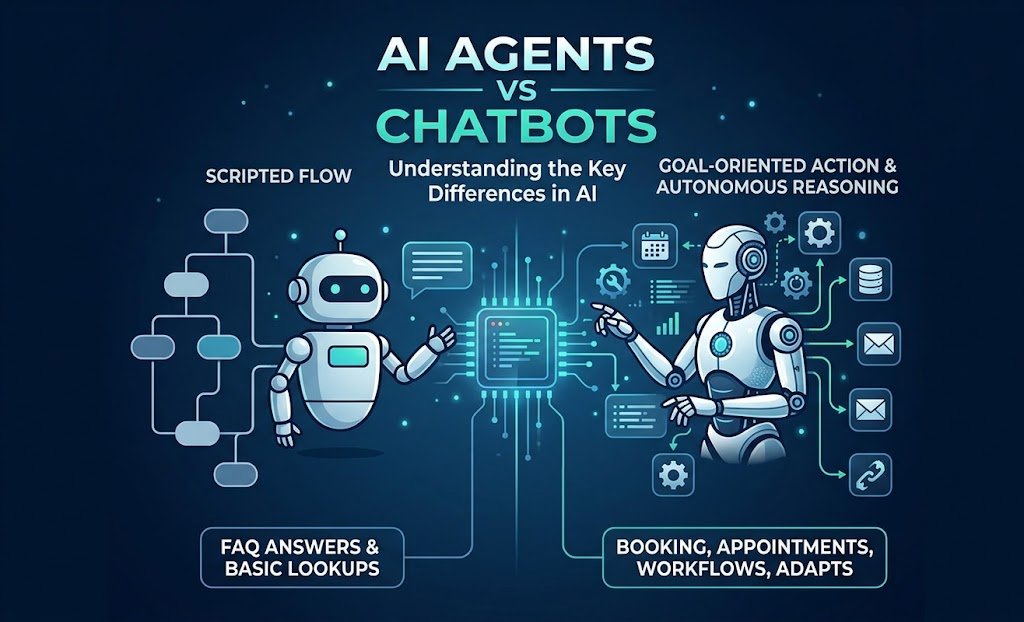
The key difference between an ai agent and a chatbot comes down to one thing: an agent works toward a goal across multiple steps and a chatbot responds to one input at a time from a script. That’s the whole answer in a sentence but let’s actually break it down.
The gap between a chatbot and an ai agent shows up most clearly once a conversation goes somewhere the script did not expect. A chatbot and ai agent might both start a conversation the same way but only one of them can adapt mid conversation without a human stepping in to patch the flow.
| Chatbot | AI Agent | |
|---|---|---|
| Decision style | Fixed script or decision tree | Reasons through the situation |
| Handles unexpected input | Poorly, often loops or fails | Adjusts and continues |
| Works across multiple steps | Rarely, usually single reply | Yes, plans and follows through |
| Memory of the conversation | Limited or none | Tracks context as it goes |
| Setup effort | Low | Higher, needs more testing |
Differences between ai agents and older bots get more obvious the longer a conversation runs. A one message FAQ answer looks about the same either way. A five message booking flow with a schedule change halfway through does not.
Difference Between Chatbots and AI (Deep Dive)
The difference between chatbots and ai in general comes down to flexibility and that flexibility comes at a cost worth being honest about. When people search for ai agent vs chatbots comparisons, they’re usually trying to figure out exactly this trade off. Building something genuinely intelligent takes more setup time and more testing than a script based bot ever will.
Key differences between ai agents and chatbots show up in three places specifically. First, how they handle complex workflows, meaning tasks with several dependent steps like qualifying a lead then booking a slot then sending a confirmation. Second, how much ai research and tuning went into the reasoning layer versus just writing more script branches. Third, how the two options behave when something outside the expected pattern happens mid conversation.
Ai technology has moved fast enough that the line here keeps shifting and some newer chatbot platforms are quietly adding agent style reasoning on top of what used to be a plain script. So when people ask how ai agents and chatbots differ today compared to two years ago, the honest answer is the gap is still real but it’s narrower than it used to be.
Chatbots and AI Agents: Rule-Based vs Autonomous
Chatbots and ai agents solve overlapping problems but they get there completely differently under the hood.
How Rule-Based Chatbots Actually Work
A rule-based setup checks the input against a list of patterns and picks the closest match. There’s no real reasoning happening, it’s closer to a very well organized filing system than anything resembling thought. Conversational bots built this way are fast to deploy and cheap to run, which is exactly why so many small sites still use them for basic questions.
How Autonomous AI Agents Make Decisions
Autonomous ai agents work differently. They take in the conversation, reason about intent using conversational ai underneath, decide on an action, then check the result before deciding what comes next. This is the same loop whether the workflow is booking a table or qualifying a sales lead and it happens close to real-time so the customer doesn’t feel like they’re waiting on a form to process.
Real-time data plays a bigger role here too. An agent can pull current availability, current pricing or current order status mid conversation, where a scripted bot usually just has whatever was baked into it at build time.
AI Chatbots vs AI Agents in Customer Support
This is where the choice actually matters for most businesses I talk to. Ai chatbots handle the repetitive stuff well. Store hours order status, basic FAQs, the kind of thing that doesn’t change conversation to conversation.
Customer support built entirely on scripted bot might automate the easy 70 percent of tickets and dump the hard 30 percent straight onto human agents anyway, since anything outside the script just fails and gets escalated. A support agent style ai setup handles more of that grey area on its own, using nlp and a knowledge base to pull the right answer instead of matching a fixed keyword.
Automation done well here means human intervention only kicks in for genuinely complex or sensitive situations, not for every third message. Generative ai and large language models sitting under a modern bot let it read intent from natural language instead of exact phrasing, which is honestly the single biggest jump from the old keyword matching era.
If you’re running WhatsApp, website chat or Instagram DMs for support, this is exactly the kind of setup our WhatsApp automation builds handle, blending scripted speed for simple stuff with agent reasoning for anything that needs it.
Use Case: When to Use an AI Agent vs a Chatbot
Here’s the practical version, since that’s probably what you actually came for.
Use a chatbot when the use case is narrow and predictable. FAQ pages order status lookups, store hours, that kind of thing does not need ai agent platform level complexity. A simple ai chatbot covers it fine and costs less to run.
Use an ai agent when the task has real decision points. Lead qualification through LinkedIn outreach, appointment booking that needs to check a live calendar or WhatsApp qualification bots that need to ask follow up questions based on what the person just said, these are the situations where ai agents offer something a script cannot. Businesses running LinkedIn automation for outbound already lean on agent style follow up sequences because a flat script cannot adjust tone based on how a prospect replies.
A quick way to decide, honestly: chatbot vs agent really comes down to this, a chatbot may work fine if you could draw the whole conversation on one page as a flowchart. If you can’t, you’re probably looking at agent territory when comparing ai agent vs chatbot for your actual workflow.
Ai solutions and ai tools built for this middle ground keep expanding too and ai platforms now often let you mix both approaches, with proper integration into your CRM or booking system, in the same build rather than picking one exclusively. Ai agents are built for the parts of a workflow that used to require a person watching a dashboard and ai agents can take that watching and turn it into action without someone clicking approve every time. Businesses running GoHighLevel workflow automation often start with basic bots and layer in agent style qualification once volume grows enough to justify it.
Let’s take the busywork off your plate.
Book a free 30-minute call and we’ll map out exactly where automation can save you hours every week — no pressure, no jargon.
FAQs About ai agents vs chatbots
u003cstrongu003eWhat is the difference between an AI agent and a chatbot?u003c/strongu003e
A chatbot answers from a fixed script or decision tree one message at a time. An ai agent reasons through a situation and works toward a goal across multiple steps, adjusting as new information comes in.
u003cstrongu003eIs ChatGPT a chatbot or an AI agent?u003c/strongu003e
On its own it behaves more like a conversational assistant than a full agent, since it mainly responds to prompts. Once it’s connected to tools that let it take actions and check results, that setup starts functioning as an agent.
u003cstrongu003eWhat is agentic AI?u003c/strongu003e
Agentic ai refers to ai systems that act with some independence toward a goal rather than only responding to a single request and stopping there.
u003cstrongu003eWhen should I use an AI agent instead of a chatbot?u003c/strongu003e
Use an agent when the task involves several dependent steps or needs to check live information, like booking a slot or qualifying a lead through a conversation that could go several directions.
u003cstrongu003eCan a chatbot become an AI agent?u003c/strongu003e
Not exactly on its own but a chatbot platform can be upgraded by adding a reasoning layer and tool access on top of the existing script, which effectively turns parts of it into agent behavior.
u003cstrongu003eWhat is a rule-based chatbot?u003c/strongu003e
It’s a bot that matches customer input against a fixed set of patterns or a decision tree and replies from a predefined list of answers, with no real reasoning involved.
u003cstrongu003eAre AI agents autonomous?u003c/strongu003e
They can act independently within limits someone sets. Autonomous doesn’t mean unsupervised, most real setups include checkpoints for anything sensitive or high stakes.
u003cstrongu003eWhat is conversational AI?u003c/strongu003e
It’s the broader category of ai that handles natural language conversation, covering everything from basic scripted bots to full reasoning agents, depending on how it’s built.
u003cstrongu003eDo AI agents need human intervention?u003c/strongu003e
Usually yes for edge cases or anything involving money or sensitive data. Most production agents are built with a clear handoff point rather than running with zero oversight.
u003cstrongu003eWhat is the difference between a chatbot and a virtual assistant?u003c/strongu003e
A virtual assistant typically responds to direct one off requests, similar to a chatbot, while an agent chases an outcome across a longer conversation without needing a new prompt for every step.
u003cstrongu003eCan AI agents work without a script?u003c/strongu003e
Yes, that’s actually the point. Instead of following a fixed script, they reason through the conversation and decide their next move based on context and the goal they’re working toward.
u003cstrongu003eWhat is an autonomous agent vs a bot?u003c/strongu003e
A bot generally follows fixed rules and can’t adapt outside them. An autonomous agent adjusts its approach mid task based on new information, which is the core distinction people are usually asking about.
u003cstrongu003eWhich is better for customer support, a chatbot or an AI agent?u003c/strongu003e
It depends on your ticket mix. If most questions are simple and repetitive, a chatbot alone works fine and costs less. If a good chunk need follow up questions or account specific answers, an agent setup handles more of that without escalating everything to a human.
Which One Should You Build First?
Start with a chatbot if your use case is genuinely simple, since there’s no reason to pay for agent complexity you won’t use. Move to agent territory once you notice the same complicated conversations getting escalated to your team over and over, because that’s usually the clearest sign a script has hit its ceiling.
If you’re not sure which side of that line your business sits on, that’s exactly the kind of thing worth a quick conversation before you build anything.