If you have ever opened your Zapier dashboard and seen a warning that you are close to your task limit for the month, you already know why so many people start typing n8n vs zapier into Google. That warning usually shows up at the worst time, right when a client campaign is running or an order is about to ship. I have been building automation stacks for small businesses for years now and this exact moment is where most people start looking for something else.
This piece walks through n8n vs zapier pricing, the real difference in how each automation platform handles tasks, what each one offers for ai workflow building, and when a self hosted setup actually makes sense. By the end you will know whether n8n or zapier for business fits your team better, or whether Make deserves a look too. And if you would rather not build any of this yourself, ThinkAIWorks sets up automation for ecommerce and lead gen teams every week, so we will point out where that fits along the way too.
What Is n8n vs Zapier
n8n is a workflow automation tool that you can run in the cloud or host yourself, built around a visual canvas where you connect nodes instead of writing raw code. Zapier is a cloud based automation platform where you build zaps that trigger one app action from another, with almost no setup needed. In short, n8n vs zapier comes down to control and pricing model versus speed and simplicity. Zapier is a cloud based service you never touch outside your browser. n8n is a workflow automation platform you can either rent in the cloud or run yourself.
n8n vs Zapier Pricing Breakdown
How Zapier Task Based Pricing Works
Zapier bills you by the task, and a task is counted every single time one step in your zap runs successfully. If you have a five step zap that fires two hundred times a month, that is a thousand tasks, not two hundred. This tasks vs execution question trips up a lot of new users because the pricing feels simple until you actually build something with branches or filters. Zapier plan tiers jump fast once you cross a few thousand tasks, and that is usually the exact moment someone starts asking about a self hosted zapier alternative.
How n8n Execution Based Pricing Works
n8n uses an execution-based pricing model instead, meaning you pay per workflow run, not per individual step inside it. That five step zap from the Zapier example above counts as one execution in n8n, not five. This is the single biggest reason people switch once their automation gets complex. n8n cloud uses this same execution model, and if you self host n8n, you are not billed per execution at all, you are just paying for your own server.
Real Cost Example at Scale
Here is a rough comparison for a business running around ten thousand automation runs a month with multi step workflows.
| Platform | Pricing model | Rough monthly cost at scale |
|---|---|---|
| Zapier | Per task, every step counts | 300 to 600 dollars or more |
| n8n Cloud | Per execution, not per step | 50 to 150 dollars |
| n8n Self Hosted | Flat server cost, unlimited executions | 10 to 40 dollars in hosting |
Numbers shift based on your exact workflow complexity, but the pattern holds. Zapier starts to feel expensive fast once your workflows have more than two or three steps running at volume.
Zapier Task Limits and Why Teams Hit the Ceiling
Zapier task limits catch people off guard because the plan you pick when you are testing rarely matches the plan you need once things go live. Every filter, every formatter step, every path in a multi step zap eats into your task count. A single new order in Shopify might trigger five or six tasks once you add a Slack alert, an inventory check, and a customer email.
Zapier is the right choice when your automation stays simple, maybe a form submission that creates a lead in your CRM and sends one notification. Once you start chaining conditional logic and multiple apps together, that same simplicity starts working against your bill. Zapier connects thousands of apps with almost zero setup time, which is genuinely the best reason to use zapier for a small, low volume workflow.
AI Features: n8n vs Zapier AI Workflow Capabilities
Zapier Native AI Actions
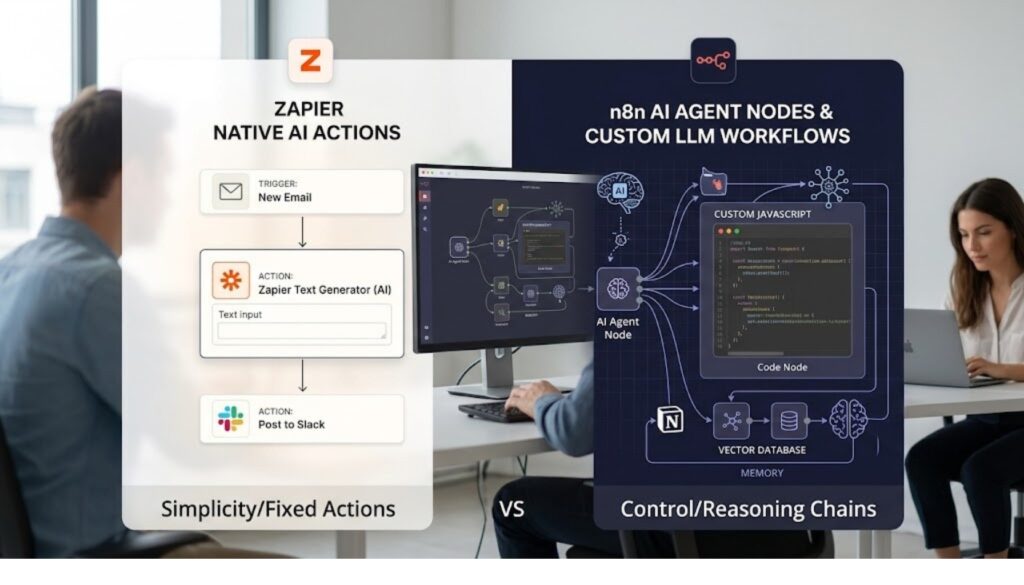
Zapier includes built in AI steps you can drop into any zap, plus a feature called code by zapier that lets you write small JavaScript or Python snippets without leaving the platform. For anyone who wants ai workflow steps without touching a real code editor, this is genuinely convenient.
n8n AI Agent Nodes and Custom LLM Workflows
n8n takes a different approach here. It offers dedicated AI agent nodes that let you build actual reasoning chains, connect vector databases, and run custom prompts with far more control over the logic than Zapier allows. If you want an automation to make a real decision based on context rather than just trigger a fixed action, n8n actually gives you more room to build that out. So which wins on ai features? For simple AI text generation inside an existing zap, zapier excels. For building a genuine AI agent with memory and tool access, n8n wins by a wide margin.
Self Hosted n8n vs Cloud Zapier: Control, Data, and Cost
What Self Hosting n8n Actually Involves
You can self host n8n on your own server, whether that is a small cloud VM or an on premise machine your IT team manages. Running n8n on your own server means your workflow data never leaves your infrastructure, which matters a lot if you handle sensitive customer records or work in a regulated industry.
A self hosted n8n instance does need someone to keep it updated and running. It is not zero maintenance the way n8n cloud is. But once it is set up, you get full control over data retention, custom nodes, and integrations that are not officially supported anywhere else.
Self Hosted Zapier Alternative: Why Businesses Search for This
There is no official way to self host Zapier since it is a cloud based product start to finish. That gap is exactly why so many people search for a self hosted zapier alternative and land on n8n instead. A few real reasons teams make that move:
- They need full data residency for compliance reasons and cannot send customer data to a third party server.
- Their task volume makes Zapier pricing unworkable at scale.
- They want custom nodes for internal tools that no public integration covers.
- They already run their own infrastructure and would rather host one more service than pay a growing monthly bill.
If your team is weighing this exact decision, this is where our automation setup work usually starts. We build and host n8n instances for ecommerce and lead generation clients who need that level of control, and we can walk you through whether self hosting actually saves you money once server and maintenance time is factored in.
n8n vs Zapier vs Make: Where Make Fits In
You cannot really talk about n8n vs zapier without someone bringing up Make, formerly Integromat. Make sits somewhere between the two. Its visual builder is closer to n8n in complexity, but it stays fully cloud based like Zapier, with its own operation based pricing model. So where does Make land in an n8n vs make vs zapier comparison?
It is often cheaper than Zapier at moderate volume, more visual than raw n8n for non technical users, but it still lacks the self hosting option and the deeper AI agent tooling n8n offers. Zapier vs Make often comes down to app coverage, since Zapier still connects more apps out of the box. Whether you should pick zapier or make usually depends on whether you need Zapier’s massive app library or Make’s cheaper pricing at mid volume.
n8n or Zapier for Business: Which Should You Choose
The honest answer is that neither tool is universally better. It depends on your team’s technical comfort, your budget, and how complex your workflows get.
| Situation | Better fit |
|---|---|
| Small team, simple one step automations, no developer on staff | Zapier |
| Growing team, multi step workflows, cost sensitive | n8n Cloud |
| Data privacy requirements, custom integrations, technical staff | n8n Self Hosted |
| Need the widest app library, willing to pay for convenience | Zapier |
| Building real AI agents with memory and tool use | n8n |
If your team leans technical and your automation is already getting complicated, think n8n first. If you need something running in twenty minutes with zero setup and your volume stays low, choose zapier and revisit the decision once you outgrow it. Choosing between n8n and zapier is rarely permanent. A lot of businesses we work with actually start on Zapier, hit the task limit wall, then move core workflows to a self hosted n8n instance once volume justifies it. This n8n vs zapier decision usually gets easier once you actually price out your real monthly task count instead of guessing.
Integrations: How Zapier and n8n Connect Your Apps
Zapier supports well over seven thousand app integrations, which is still the largest library in the space and the main reason zapier handles everything for teams juggling a dozen different tools. n8n integrates with a smaller official list, usually a few hundred native nodes, but it makes up ground with HTTP request nodes and webhook support that let you connect almost any app with an API, even without an official integration.
Zapier and n8n both let you build multi app chains, but the experience differs. Zapier and n8n users both rely on triggers and actions as the core building blocks. Where Zapier allows a mostly drag and drop setup, n8n allows a bit more custom logic between steps, including code nodes for JavaScript when you need something an app icon cannot handle. If your stack is unusual or homemade, n8n supports building a custom connection where Zapier simply cannot.
Migrating from Zapier to n8n or the Other Way Around
Moving from zapier to n8n is not a one click process, but it is not brutal either. Here is the rough path most teams follow.
- List every active zap and note what triggers it and what actions it performs.
- Rebuild the simplest, lowest risk zap first inside n8n to learn the node logic.
- Run both versions in parallel for a week or two to confirm outputs match.
- Switch the trigger source over once you trust the n8n version.
- Repeat for each remaining zap, saving the most complex ones for last.
n8n allows you to import some workflows directly if you are moving from Make, though Zapier does not offer a native export format, so most zapier to n8n migrations involve manual rebuilding. If you would rather skip this process entirely, our team handles full migrations for clients moving off Zapier, including automation for WhatsApp lead qualification and Shopify order workflows that got too expensive to run on task based pricing.
Final Verdict: n8n vs Zapier vs Make in 2026
There is no single winner here, and honestly anyone who tells you there is one has not run both platforms at real volume. Zapier is a cloud based automation platform that is perfect for speed and simplicity when your workflows stay light. n8n is a workflow automation platform built for teams who want more control, better AI agent tooling, and a pricing model that does not punish you for building something complex. Make sits in between and deserves a look if app coverage matters less to you than cost.
If you are still stuck on the n8n vs zapier decision, start with your actual task volume and your team’s comfort with a slightly steeper learning curve. That number will tell you more than any comparison article, including this one.
Need help setting any of this up. ThinkAIWorks builds automation for GoHighLevel pipelines, AI chatbots for business, and full lead generation stacks, and we can tell you within one call whether n8n or Zapier is the right call for your specific setup.
How Think AI Works Solves the Lead Follow-Up Problem
Most businesses that come to us aren’t missing leads. They’re missing the system that catches them. A lead comes in through a form, an ad, or a WhatsApp message, and it sits in an inbox until someone has a free minute. By then the moment’s gone.
We build the automated lead follow-up system around wherever your leads actually come from, not just one channel. That means the trigger fires the second a lead enters your CRM, whether that lead started on a landing page, a Meta ad, or a WhatsApp conversation.
Instant Response Without Adding Headcount
You don’t need a bigger sales team to follow up faster. You need the first message to go out automatically, then a person to step in once someone actually replies. That’s the balance we build every workflow around.
One Pipeline, Every Lead Source Connected
If leads come in through five different channels and land in five different places, half of them get missed by default. We pull every source into one pipeline through our GoHighLevel automation setup, so nothing depends on someone remembering to check a second inbox.
Follow-Up That Adapts to Each Lead
Not every lead should get the same sequence. A warm lead ready to book and a cold one that just downloaded a guide need different messages at different speeds. We build the logic so the system tells the difference, using lead scoring to decide who gets a fast direct offer and who goes into a longer nurture track.
Why Choose Think AI Works for Lead Follow-Up Automation
Plenty of agencies will set up a follow-up email and call it automation. We build the full loop, capture, trigger, sequence, and handoff, so nothing depends on a person remembering a step.
What we bring that’s harder to copy is the combination. We’re not just a CRM reseller and we’re not just a chatbot shop. We connect lead capture, WhatsApp and email follow-up, AI-assisted scoring, and CRM workflows into one system, which means fewer handoffs between tools and fewer places for a lead to get lost.
We also don’t hand you a finished automation and disappear. Sequences get reviewed and adjusted based on what’s actually converting, not left running on autopilot from day one. That ongoing part is where most DIY setups fall behind, since a sequence built once in January rarely still fits how leads behave by summer.
Benefits of Working With Think AI Works
The real value isn’t the automation itself, it’s what stops happening once it’s running.
- Leads stop sitting unanswered overnight or over a weekend, since the first message goes out the moment they come in.
- Your sales team spends time on leads that are actually engaged instead of working through a list in order.
- Follow-up stays consistent even during busy weeks, so nothing slips just because someone was slammed with other work.
- Reporting shows which messages in the sequence are actually landing, so the follow-up system gets better over time instead of staying static.
- You get one pipeline instead of leads scattered across email, WhatsApp, and ad platform inboxes.
Each of these ties back to the same problem this article opened with. A lead that goes cold overnight isn’t a sales problem, it’s a system problem, and that’s the part we’re built to fix.
Case Study: Fixing a Broken Follow-Up Process
The problem. A client running lead generation through Meta ads and a website form was losing a noticeable share of leads simply because responses depended on whoever was free that day. Leads that came in after hours or over the weekend often didn’t get a reply until the following business day, by which point several had already gone with a competitor.
The approach. We mapped every point a lead could enter the business, the ad form, the website, and WhatsApp enquiries, into a single CRM pipeline. From there we built an automated follow-up sequence that fired an instant confirmation message, followed by a short value message within a day, and a direct offer if there was still no reply after that.
The solution. Lead scoring was added so replies showing real intent got routed straight to the sales team, while lower intent leads moved into a longer nurture sequence instead of getting dropped entirely. Nothing sat waiting on a person to notice it.
Let’s take the busywork off your plate.
Book a free 30-minute call and we’ll map out exactly where automation can save you hours every week — no pressure, no jargon.
Frequently Asked Questions
u003cstrongu003eIs n8n better than Zapier?u003c/strongu003e
It depends on what you need. n8n is better for complex workflows, AI agents, and teams that want self hosting. Zapier is better for speed and simplicity when your automation stays basic.
u003cstrongu003eIs n8n free to use?u003c/strongu003e
n8n offers a free self hosted version if you run it on your own server. n8n cloud has paid plans, though it usually costs less than Zapier at the same volume.
u003cstrongu003eWhat are Zapier task limits?u003c/strongu003e
A task is counted every time one step in a zap runs. Multi step zaps use up your task count fast, which is why teams on Zapier plans hit limits sooner than expected.
u003cstrongu003eCan I self host n8n for free?u003c/strongu003e
Yes. n8n can be self hosted at no software cost, though you still pay for the server it runs on and someone needs to maintain it.
u003cstrongu003eDoes n8n have AI features like Zapier?u003c/strongu003e
Yes, and in some ways n8n goes further. Zapier offers built in AI actions and code by zapier for quick scripting. n8n offers full AI agent nodes for building more complex reasoning chains.
u003cstrongu003eIs n8n harder to learn than Zapier?u003c/strongu003e
A little, yes. Zapier focuses on simplicity with a very shallow learning curve. n8n takes a bit more time to learn since it exposes more of the underlying logic.
u003cstrongu003eWhat is the difference between n8n, Zapier, and Make?u003c/strongu003e
Zapier is cloud only with the largest app library. Make is cloud only with cheaper pricing at mid volume. n8n is the only one of the three that can be self hosted.
u003cstrongu003eHow much does Zapier cost for a small business?u003c/strongu003e
Entry plans start low, but costs climb quickly once you add multi step zaps or higher task volume. Many small businesses find themselves needing a mid tier plan within a few months.
u003cstrongu003eCan I migrate my Zapier zaps to n8n?u003c/strongu003e
Yes, though it usually means rebuilding each zap manually inside n8n since there is no direct import tool from Zapier.
u003cstrongu003eIs n8n good for enterprise businesses?u003c/strongu003e
Yes. Enterprise teams often choose a self hosted n8n instance for data control, and n8n also offers dedicated enterprise support and features for larger deployments.
u003cstrongu003eDoes Zapier offer a self hosted version?u003c/strongu003e
No. Zapier is a cloud based service only. This is exactly why people search for a self hosted zapier alternative and usually end up looking at n8n.
u003cstrongu003eWhat counts as a task in Zapier?u003c/strongu003e
Every action step that runs successfully counts as one task, including formatter steps, filters, and any app action inside a multi step zap.
u003cstrongu003eIs n8n more secure than Zapier?u003c/strongu003e
Security depends on setup either way, but a self hosted n8n instance gives you direct control over where your data lives, which some industries require.
u003cstrongu003eWhich is cheaper at scale: n8n or Zapier?u003c/strongu003e
n8n is almost always cheaper at scale because of its execution-based pricing model, especially if you run a self hosted n8n version instead of n8n cloud.
u003cstrongu003eShould a small business choose n8n or Zapier?u003c/strongu003e
For a small business with simple, low volumeu003ca href=u0022https://thinkaiworks.com/ai-automation-for-logistics-courier/u0022 data-type=u0022linku0022 data-id=u0022https://thinkaiworks.com/ai-automation-for-logistics-courier/u0022u003e automationu003c/au003e, Zapier is usually the better choice. Once workflows grow past a handful of steps or you need AI agents, n8n is best.
Sources and further reading:n8n official documentation and pricing page, Zapier official help center and pricing page, G2 comparison reviews for workflow automation software.