
Table of Contents
Ever wondered what are AI agents? You have probably heard the term thrown around in meetings or LinkedIn posts and nodded along without really knowing what it means. That is fine. Most people are in the same boat right now.
An ai agent is not just another chatbot with a fancy name. It is software built to look at a situation, decide what to do about it and then actually go do it, often without someone clicking a button at every step. That is the short version. The long version is what this whole piece is for.
By the end you will know what an ai agent actually is, how the agent loop works under the hood, the different types of ai agents you will run into and where businesses like yours are already using ai agents to pursue real goals instead of just answering questions. That is the core idea behind ai to pursue an outcome rather than just react to one message. If you run a business and want to see this stuff in action rather than just read about it, tools like an ai chatbot for business already use a lot of these same ideas today.
What Is an AI Agent? A Simple Definition
An ai agent is a piece of software that can sense what is happening around it, make a decision based on that information and take action toward a goal, usually with little or no human hand holding along the way. That is the plain answer. Everything else in this article builds on that one idea.
AI Agent Definition for Business Owners
Think about a regular piece of software. You tell it exactly what to do, step by step and it does that one thing every single time. An ai system built as an agent works differently. You give it a goal like qualify this lead or answer this customer question and it figures out the steps on its own.
This is really what people mean when they say agentic ai. The word sounds technical but the idea is simple. It is ai that acts with some independence instead of just responding to a single command and stopping there.
AI Agent vs Regular Software
Here is the part most people miss. Traditional software is a system. An agent is a system too but it is one that plans and adjusts as it goes. A basic invoice tool is not an agent because it just does the same fixed task. An ai model wired up to reason, check tools and adjust its next move based on new information, that is closer to what we are talking about.
Honestly, this distinction is becoming more of an ai foundation for how software gets built. At its core an agent is a software layer wrapped around a model and it is starting to feel essential for ai products going forward, not just a side feature bolted onto an app.
How Do AI Agents Work? The Agent Loop Explained
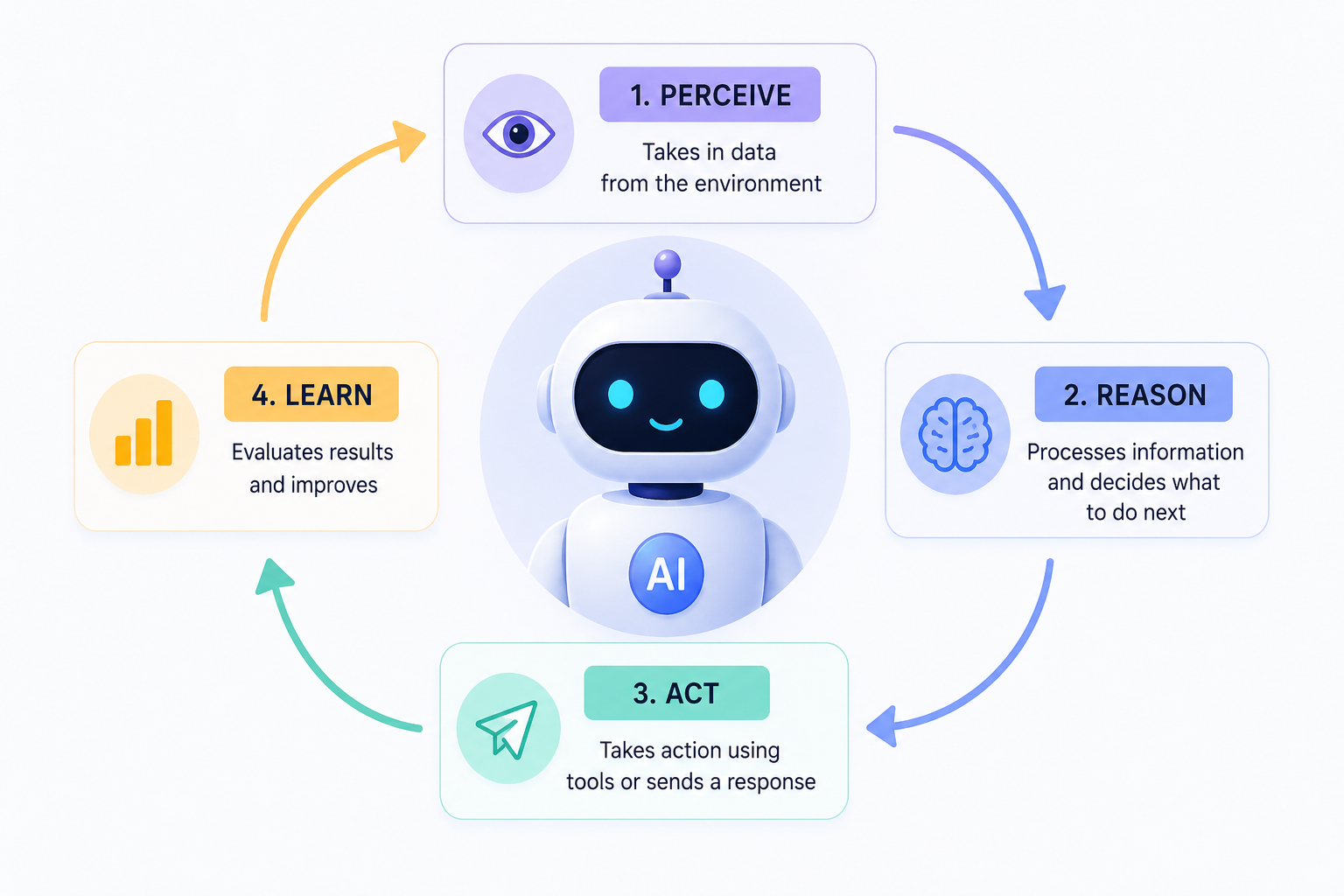
At the core, ai agents work through a repeating cycle. It looks at information, thinks about what that information means, picks an action and then checks the result before doing it all again. People call this the agent loop and once you understand it, a lot of the mystery falls away.
The Agent Loop: Perceive, Reason, Act
Step one is perceiving. The agent takes in data, this could be a customer message, a spreadsheet update or a webhook from another tool. Step two is reasoning. The agent evaluates what it just saw against its goal and works out what to do next. Step three is acting. It sends the message, updates the record or calls another tool.
Then the loop starts over. The agent operates on the new state of the world, not the old one. This is the part that trips a lot of people up because it feels almost human. The agent interacts with its environment, agents follow a plan and agents act only once the reasoning step is done, adjusting when something does not go as expected. If a customer replies with an unexpected question halfway through a booking flow, a well built agent performs a fresh reasoning step instead of just crashing or repeating itself.
Why an LLM Sits at the Core
Most modern agents run on an llm underneath. The llm is what handles the reasoning part, turning messy human language into a structured decision the agent can act on. Without it, you are back to old school rule based bots that break the moment someone phrases things differently than expected.
An agent requires more than just the model though. It needs memory, a way to call tools and rules about when to stop and ask a human for help. That is the actual engineering work and it is where a lot of projects either work well or fall apart.
Types of AI Agents (With Real Examples)
Not every agent works the same way and honestly the differences matter more than most articles let on. Types of ai agents include reflex based ones, goal driven ones and learning ones and here are the ones you will actually come across.
Simple Reflex Agent
A simple reflex agent reacts to what it sees right now with no memory of the past. If X happens, do Y. This is the most basic kind, useful for things like an automated reply that fires the moment a certain keyword shows up.
Model-Based Reflex Agents
Model-based reflex agents keep a bit of internal state, a rough model of the world, so they can handle situations the simple version cannot. They remember what happened a step or two ago and factor that into the next decision.
Goal-Based Agents
Goal-based agents work backward from an outcome. Instead of just reacting, they plan a path toward a specific target, like getting a lead to book a call.
Utility-Based Agent
A utility-based agent goes a step further and weighs multiple possible actions against each other, picking whichever one scores best against some measure of value, not just whichever one technically satisfies the goal.
Learning Agent
A learning agent improves its own performance over time based on feedback. The agent learns from outcomes, good and bad and adjusts future behavior. This is closer to what people picture when they imagine truly smart software.
Hierarchical Agents and Supervisor Agent
In bigger setups you will see hierarchical agents, where a supervisor agent oversees several smaller ones and decides which one handles which task. This shows up a lot in enterprise builds where a single agent trying to do everything just gets messy.
| Type | How it decides | Example use |
|---|---|---|
| Simple reflex agent | Fixed rule for a fixed trigger | Auto reply on a keyword |
| Model-based reflex agent | Rule plus recent memory | Tracks a conversation’s last few turns |
| Goal-based agent | Plans steps toward an outcome | Books a viewing appointment |
| Utility-based agent | Weighs and scores options | Picks the best time slot for both parties |
| Learning agent | Adjusts based on past results | Improves lead scoring over months |
| Supervisor agent | Routes tasks to sub-agents | Manages a support and a sales agent together |
Intelligent agents like these are not all equally complex and honestly, most small businesses do not need a hierarchical setup on day one. A single well tuned goal-based agent handles a lot of real work.
AI Agent Architecture: What’s Under the Hood
If you strip away the buzzwords, ai agent architecture comes down to a handful of parts working together.
Core Components: Memory, Tools, Planning
Every serious agent needs three things at minimum. Memory, so it does not forget what already happened in a conversation or task. Tools, so it can actually do something like send an email, update a database or check a calendar. And a planning layer, so it breaks a big goal into smaller steps instead of trying to do everything in one shot.
Agents use a combination of these pieces and agents plan their next move based on what each component reports back. This is agent technology in its most practical form, not some abstract concept.
Single Agent vs Multi-Agent Systems
A single agent handles one job end to end. That is fine for a lot of use cases. But once the work gets complicated, businesses start running multiple agents or even multiple ai agents working in parallel on different parts of the same process.
These setups are called agentic ai systems and they are becoming more common as companies realize one agent trying to juggle sales, support and scheduling all at once tends to underperform compared to a few focused ones.
How to Use AI Agents in Your Business
This is probably the section you actually clicked for. So let’s get practical.
Common Business Use Cases
Businesses use ai agents for things that used to eat up someone’s whole afternoon. Qualifying leads, answering repetitive customer questions, following up on abandoned bookings, checking inventory, the list goes on. Ai agents often handle the boring, repetitive parts of a job so people can focus on the parts that actually need judgment.
Ai applications built this way are not about replacing your team. They are about handling the ninety percent that does not need a human brain, so the ten percent that does gets proper attention.
Customer Service Agent Example
A customer service agent is one of the easiest starting points. It answers common questions, checks order status and escalates to a human the moment something falls outside its confidence. Businesses running a website or WhatsApp bot have already seen this in messaging apps, where agents handle the first reply and only loop in a real person when needed.
Agents perform tasks like this well because the questions are repetitive enough to predict but varied enough in wording that old school scripted bots used to fail constantly.
Data Agents and Coding Agent Examples
On the more technical side, data agents pull, clean and summarize numbers from spreadsheets or dashboards without someone manually exporting a CSV every Monday morning. A coding agent, meanwhile, can review code, suggest fixes or even write small scripts on request.
Ai agents use a combination of tool access and reasoning to pull this off and agents often use the same underlying model for both jobs. Restaurants use ai agents to handle reservations through WhatsApp automation, confirming bookings and sending reminders without staff manually texting every table back and forth.
AI Agents vs AI Assistants vs Chatbots
People use these words interchangeably and it causes real confusion, so let’s clear it up.
Key Differences
Ai assistants, like the one you might use to draft an email, mostly respond to direct requests. They do not usually chase a goal on their own once you close the app. Chatbots are typically scripted or lightly ai powered, answering from a fixed set of possible replies.
Agents are ai systems built to keep working toward an outcome across multiple steps, checking in with tools or people along the way and the gap between agents and ai assistants really comes down to how many steps they can carry on their own. Human agents in a call center still exist for a reason, some conversations need real judgment and empathy that software cannot fake convincingly yet.
When Each Makes Sense
If you just need quick answers to FAQs, a chatbot might be enough. If you need something that drafts and edits on request, an assistant fits. If you need something that chases a lead through five messages until a booking is confirmed, that is agent territory. Ai agents are often the right call once a task has more than one decision point in it.
| Tool | Works toward a goal over time | Typical use |
|---|---|---|
| Chatbot | No, mostly scripted | FAQ answers |
| AI assistant | Limited, per request | Drafting content, quick tasks |
| AI agent | Yes, multi step | Lead qualification, booking flows |
How to Deploy AI Agents (Step by Step)
Getting an agent live is not as scary as it sounds but it does take planning.
Deployment Checklist
First, pick one narrow task. Do not try to deploy ai agents across your whole operation on day one. Second, define what success looks like in numbers, not vibes. Third, connect the tools it actually needs, calendar, CRM, messaging app, nothing extra. Fourth, set clear boundaries for when it hands off to a human.
Deployment of ai agents works best when you start small, watch it run for a couple of weeks, then expand. Companies that try to automate everything at once usually end up rebuilding from scratch six months later.
Production Agent Considerations
A production agent needs monitoring, logging and a way to catch mistakes before they reach a customer. This is different from a demo that works fine in testing but falls apart under real traffic. Enterprise ai agent setups usually add extra approval steps for anything involving money or sensitive data.
Ai agents can work incredibly well once live but ai agents can make decisions that surprise you if the boundaries were not set clearly. An autonomous agent is not the same as an unsupervised one. Autonomous ai agents should still have limits on what they are allowed to do without a human check. Ai agents are autonomous within a scope you define, not beyond it.
Building and Agent Development: What It Takes
If you are thinking about building your own instead of buying something off the shelf, here is the honest picture.
Agent Development Basics
Agent development starts with defining the goal clearly, then choosing the right model, tools and guardrails. Building ai agents from scratch takes real engineering time, testing and iteration, it is not a weekend project even though some demos make it look that way.
Agentic AI Projects and Custom AI
Agentic ai projects tend to succeed when the scope stays tight. Custom ai built for one specific job, like qualifying leads from a specific ad campaign, beats a vague general purpose agent almost every time in our experience. This overlaps heavily with ai and machine learning work generally, though agents add the planning and tool use layer on top.
Advanced ai capabilities keep expanding fast and agents are built to take advantage of whatever the underlying model can do. Development and deployment of ai agents is genuinely a different skill set than traditional app development, closer to managing a very literal, very fast new employee than writing static code.
What Makes AI Agents Different From Traditional Automation
This is the question that actually matters if you are deciding whether to bother with any of this.
Agents Can Improve and Adapt Over Time
Old automation does exactly the same thing forever unless someone edits the rules by hand. Agents can improve based on outcomes. Ai agents improve their responses as they see more real conversations and an agent improves its lead scoring the more data it processes, assuming someone is actually reviewing results and adjusting the setup.
Generative AI’s Role
Generative ai is what makes the flexible reasoning possible in the first place. Generative ai models can handle language variation that would have broken a rule based system years ago. Generative ai creates the raw response and the agent framework decides when and how to use it, which tool to call and when to stop. The ai techniques behind this have moved fast in the last couple of years and honestly some of what felt experimental eighteen months ago is now just standard practice.
Where AI Agents Are Used Across Industries
Ai agents across different industries look pretty different from each other once you get into specifics.
Specialist and Specialized Agents by Industry
Real estate businesses use specialist agents for instant enquiry response and viewing bookings, similar to what real estate automation already covers, so a lead does not go cold waiting for someone to check their inbox. Ecommerce stores lean on specialized agents for abandoned cart recovery and order updates, the kind of thing ecommerce and Shopify automation is built around. Logistics teams use agents specializing in dispatch and driver performance tracking. Restaurants use them for reservations and review requests.
Specialized ai like this works because the domain is narrow enough that the agent does not need to know everything, just its one corner of the business really well.
Agents Working Together: Multi Agent Collaboration
Bigger operations often have agents that interact with other agents rather than working alone. A lead generation agent might hand off a qualified contact to a booking agent, similar to how ai lead generation setups pass leads through Meta ads or cold email into a qualification step automatically. Agents can be designed to work with other agents this way, each one doing its specific job and passing the baton and honestly this is where a lot of the real efficiency gains show up. Agents can take on narrower responsibilities when they are not trying to do the entire customer journey solo.
Discover How AI Agents Can Work for Your Business
So where does this leave you. If you have read this far, you already understand more about an ai agent’s actual mechanics than most people talking about the topic online.
Agents are useful when the task has real decisions in it, not just fixed steps. If that describes a part of your business, whether that is lead follow up, booking management or customer replies, it is worth a proper look rather than guessing. Discover how ai agents fit your specific process by starting with one narrow use case, measuring it honestly and expanding from there.
Let’s take the busywork off your plate.
Book a free 30-minute call and we’ll map out exactly where automation can save you hours every week — no pressure, no jargon.
Frequently Asked Questions
u003cstrongu003eWhat are AI agents in simple terms?u003c/strongu003e
An ai agent is software that senses information, decides what to do about it and takes action toward a goal, usually with limited need for a human to click through every step.
u003cstrongu003eHow do AI agents work?u003c/strongu003e
They run through a loop, take in information, reason about it using an llm, choose an action, then repeat the cycle based on the new result.
u003cstrongu003eWhat is agentic ai?u003c/strongu003e
Agentic ai refers to ai systems that act with some independence toward a goal rather than just answering a single request and stopping.
u003cstrongu003eWhat is the difference between an AI agent and an AI assistant?u003c/strongu003e
An assistant mostly responds to direct requests one at a time. An agent works toward an outcome across multiple steps and checks in with tools or people along the way.
u003cstrongu003eWhat is a simple reflex agent?u003c/strongu003e
It is the most basic type, reacting to a current input with a fixed rule and no memory of past interactions.
u003cstrongu003eWhat are the main types of AI agents?u003c/strongu003e
Simple reflex, model-based reflex, goal-based, utility-based, learning agents and supervisor agents that manage a group of smaller ones.
u003cstrongu003eWhat is an agent loop?u003c/strongu003e
It is the repeating cycle of perceiving information, reasoning about it and acting, which then feeds back into the next cycle.
u003cstrongu003eCan AI agents work with other agents?u003c/strongu003e
Yes, in bigger systems agents hand tasks off to each other, one might qualify a lead while another handles booking, working as a team rather than one agent doing everything.
u003cstrongu003eHow do businesses deploy AI agents?u003c/strongu003e
Start with one narrow task, define clear success metrics, connect only the tools actually needed and set boundaries for when it hands off to a human.
u003cstrongu003eWhat is the difference between AI agents and chatbots?u003c/strongu003e
Chatbots mostly answer from a fixed set of scripted replies. Agents work toward a goal across multiple steps and can take real action, not just respond.
u003cstrongu003eAre AI agents autonomous?u003c/strongu003e
They can act independently within limits you set. Autonomous does not mean unsupervised, most production setups still include checkpoints for anything sensitive.
u003cstrongu003eWhat industries use AI agents?u003c/strongu003e
Real estate, ecommerce, logistics, restaurants and lead generation are some of the more common ones right now, each using agents for their own specific repetitive tasks.
u003cstrongu003eHow do I start building an AI agent for my business?u003c/strongu003e
Pick one process that eats up real time, define what success looks like in numbers, connect the minimum tools needed and test it on a small scale before expanding.