
Table of Contents
A lead sits in your inbox for forty minutes and by the time someone calls back the prospect has already booked a demo with a competitor. That is speed to lead in a single sentence. It is the gap between a prospect filling out a form and a rep actually picking up the phone or sending a reply, and that gap decides more deals than most sales teams want to admit.
Here is the thing. Every team says they respond fast. Almost none of them actually measure it. In this piece you will get the real numbers behind lead response time, the five minute rule everyone quotes but rarely follows, and a practical way to fix your speed to lead without hiring more reps. We will also touch on how automation and an instant lead response system change the math, since that is where most of the improvement actually comes from.
What Is Speed to Lead
Speed to lead refers to the time it takes between when a prospect fills out a form, requests a demo, or otherwise raises their hand, and when a sales rep makes first contact. It is measured in minutes for inbound leads and can stretch into hours or days when a business has no system in place.
That sounds simple and it is. But the reason it gets its own name instead of just being called response time is because the size of the gap changes the outcome so dramatically. A lead comes in warm. It cools fast. The moment a prospect fills out a form they are thinking about your product. Thirty minutes later they are thinking about something else entirely, maybe a competitor’s site they opened in another tab while waiting to hear back from you.
Why Speed to Lead Matters
Speed to lead matters because conversion rate is not flat across time. It drops, and it drops fast. This is not a guess. It is one of the more studied areas in sales research and the numbers are consistent enough that they should worry anyone running a sales team.
What Harvard Business Review and Industry Data Show
A widely cited Harvard Business Review study on lead response found that firms trying to contact prospects within an hour of receiving a query were far more likely to qualify that lead than firms that waited even a little longer. The drop off after the first hour was steep enough that researchers described speed as one of the biggest levers in the whole sales process, bigger in some cases than the pitch itself.
That is a hard pill to swallow if you have spent years polishing your demo script. But it lines up with something anyone who has worked inbound sales already knows in their gut. Businesses that prioritize speed close more deals, not because their product is better, but because they are still in the room when the prospect is ready to buy.
Whether a Lead Converts Comes Down to Timing More Than People Think
There is a temptation to treat speed and quality as opposites, as if a fast response means a sloppy one. In practice they are not connected at all. A fast reply can be a single line that says you got their request and someone will call within the hour. That alone changes whether a lead converts, because it tells the prospect they are not being ignored.
Lead Response Time Statistics
Lead response time statistics are worth knowing not because you need to memorize a chart but because they give you a real target instead of a vague goal like “respond faster.”
| Response Window | Typical Conversion Likelihood | Common In |
|---|---|---|
| Within 5 minutes | Highest, often cited as 8 to 21 times more likely than 30+ minutes | B2B SaaS, real estate |
| Within 1 hour | Strong, drops sharply after this point | Ecommerce, service businesses |
| Within 24 hours | Weak, treated as cold by many prospects | Businesses without lead routing |
| 3+ days | Near zero, prospect has usually moved on | No automation in place |
Benchmarks for Speed to Lead by Industry
Benchmarks for speed to lead differ by industry. Real estate and home services tend to have the tightest windows since a motivated seller leads deal often has three or four agents calling within minutes of the form submission. B2B software sits a bit further out, usually because the buying decision takes longer overall, but even there the average response time across most companies studied was well over an hour, which is far slower than what actually converts.
How Slow Lead Response Kills Pipeline
Slow lead response does not just lose a single deal here and there. It quietly drains the whole funnel. A rep chasing a lead that has gone cold spends the same amount of time as chasing a warm one, except the odds are stacked against them from the start. Multiply that across a pipeline with a hundred leads a month and slow lead response becomes a real cost, not just a missed opportunity.
The 5 Minute Lead Response Rule
The 5 minute lead response rule says a business should make first contact with a new lead within five minutes of the form being submitted, because conversion odds drop sharply after that window closes.
Where the 5 Minute Rule Comes From
The number itself comes from research into how prospects behave right after filling out a form. Within 5 minutes, most people are still on your site or still thinking about the product they just requested information on. Wait much longer and their attention has usually moved somewhere else, sometimes to a competitor, sometimes just back to their inbox and the fifty other things on their plate that day.
Is 5 Minutes Realistic for Every Team
Honestly, no. Not every team can staff someone to sit by the phone all day, and for a lot of businesses that is not even the right use of a rep’s time. This is where automated lead routing and an instant lead response system earn their keep. A bot or automated message can acknowledge the lead within five minutes even if a human follow up takes a bit longer, and that first response is often enough to keep the prospect engaged until a rep can jump in.
How Speed to Lead Impacts B2B and Inbound Sales
For B2B teams running any kind of inbound lead program, speed to lead is often the difference between a full calendar and an empty one. A demo request that sits unanswered for a day is, in most cases, a demo that never happens.
Inbound Lead Flow From Form Fill to Demo
Think about the actual path. A prospect fills out a form, maybe after reading a blog post or comparing two vendors. If a sales rep responds within minutes, the prospect is still in research mode and open to a conversation. If the reply comes a day later, they have usually already scheduled a meeting with someone else or lost interest in the whole idea.
B2B Lead Generation and the Cost of Delay
Companies spend real money on b2b lead generation, whether that is paid ads, LinkedIn outreach, or cold email. Every hour a new lead sits unanswered is money spent to generate interest that quietly evaporates. This is one of the more overlooked costs in a sales org, because it does not show up as a line item anywhere. It just shows up as a lower conversion rate no one can quite explain.
Lead Scoring, Qualification, and Routing
Not every lead deserves the same five minute response, and that is where lead scoring and lead routing come in. Lead scoring ranks incoming leads by how likely they are to buy, based on things like company size, product interest, or how they found you. Lead routing then sends that lead to the right rep automatically instead of leaving it in a shared inbox for whoever notices first.
Manual vs Automated Lead Assignment
| Manual Lead Assignment | Automated Lead Routing |
|---|---|
| A rep or manager checks the inbox and assigns leads by hand | Leads to the right salesperson happen instantly based on rules |
| Prone to delay when the assigner is busy or out | Runs 24/7 without needing a person watching |
| Easy to set up with no tools | Needs a CRM or automation platform |
| Works fine at low lead volume | Scales cleanly as volume grows |
Manual lead assignment works fine when you get five leads a week. It falls apart fast once volume grows, and that is usually the point where a business starts losing leads simply because nobody treats lead routing as a real process, just something that happens whenever someone has a spare minute.
Motivated Seller Leads and Time Sensitive Verticals
In real estate, motivated seller leads are about as time sensitive as it gets. A homeowner filling out a form to get a cash offer is often talking to two or three companies at once, and whoever calls first usually wins the conversation before the others even get through. ThinkAIWorks builds automation for exactly this kind of scenario through its real estate automation service, handling instant enquiry response and lead qualification so a homeowner hears back in minutes instead of hours.
How to Improve Your Speed to Lead
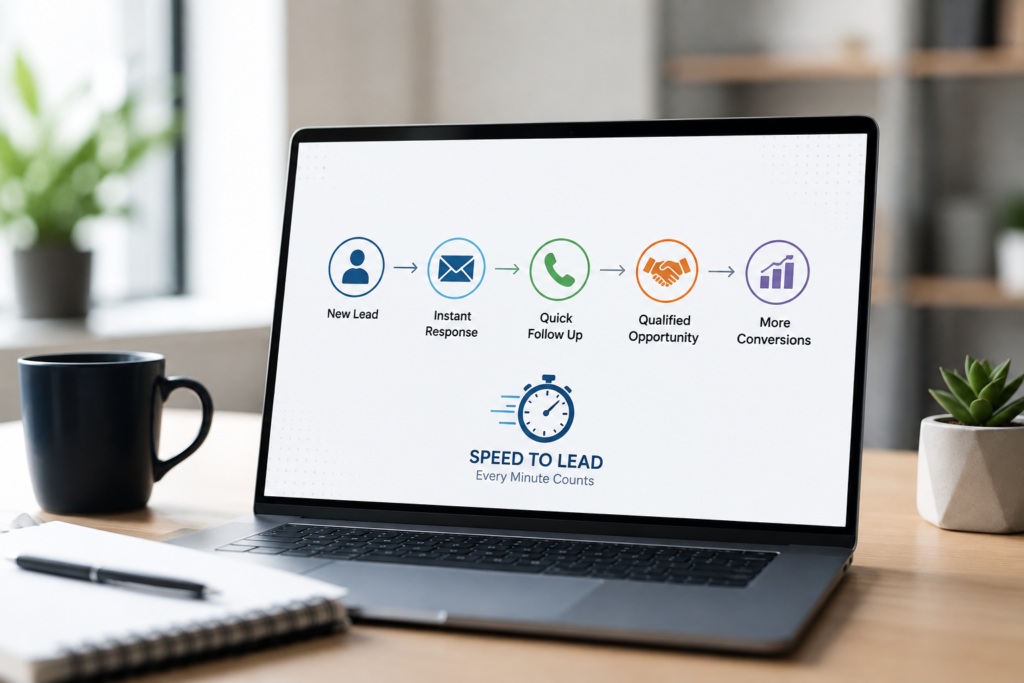
If you want to improve your speed to lead, the fix is rarely about working harder. It is almost always about building a system that does not depend on a person noticing a new lead in real time.
Step 1: Instant Lead Response System Setup
Set up something, anything, that fires the moment a lead fills out a form. Even a simple auto reply that says thanks for reaching out and someone will call shortly buys you time and keeps the lead warm while a rep gets looped in.
Step 2: CRM and Automation Stack
A decent crm paired with automation software closes most of the gap on its own. The lead comes in, gets logged automatically, and triggers a notification without anyone having to check email every ten minutes.
Step 3: Automated Lead Routing Rules
Set rules so a lead reaches the right rep based on territory, product interest, or deal size. This is the part that lets a small sales team punch above its weight, since nobody wastes time reassigning leads by hand.
Step 4: Rep Notification and Follow Up Cadence
Reps need more than a single alert. Build a short follow up cadence so leads that do not answer the first call still get a text or email within the hour instead of falling through the cracks.
Speed to Lead Automation Tools and Software
Speed to lead automation is where most of the actual improvement happens, because software does not get busy, take lunch, or forget to check the inbox on a Friday afternoon.
An instant lead response system built on a proper crm and automation platform means a new lead gets acknowledged the second it comes in, then routed, then followed up on without a rep lifting a finger for the first step. ThinkAIWorks sets this kind of pipeline up through its GoHighLevel automation service, building custom workflows and funnel pages that catch a lead the moment it lands. For businesses that get most of their inbound through chat, an AI chatbot for business can handle that first response on WhatsApp, the website, or Instagram before a human even sees the message, which is often the single biggest lever for cutting response time to near zero.
Speed to lead software is not one tool. It is usually a stack: a form that fires a webhook, a crm that logs the lead, and a routing layer that gets it to the right person. Teams that close more deals almost always have all three working together instead of relying on one piece doing everything.
How to Monitor Your Speed to Lead
You cannot fix what you do not measure. Monitor your speed to lead the same way you would track any other pipeline metric, weekly if possible, since averages hide a lot.
KPIs to Track Weekly
Track average response time by rep, not just team wide, since one slow responder can drag the whole number down without anyone noticing. Pair that with conversion rate by response window so you can actually see where the drop off happens in your own pipeline instead of relying on someone else’s benchmark.
Speed to Lead in 2026
Speed to lead in 2026 looks different than it did five years ago mostly because prospects now expect an instant reply the same way they expect a text message to get read within minutes. Lead quality still matters, and speed matters just as much, maybe more, since the businesses that prioritize speed to lead are the ones setting the new baseline everyone else has to compete against. The best leads still go cold if nobody calls them back in time, no matter how well qualified they were on paper.
How Think AI Works Solves the Lead Follow-Up Problem
Most businesses that come to us aren’t missing leads. They’re missing the system that catches them. A lead comes in through a form, an ad, or a WhatsApp message, and it sits in an inbox until someone has a free minute. By then the moment’s gone.
We build the automated lead follow-up system around wherever your leads actually come from, not just one channel. That means the trigger fires the second a lead enters your CRM, whether that lead started on a landing page, a Meta ad, or a WhatsApp conversation.
Instant Response Without Adding Headcount
You don’t need a bigger sales team to follow up faster. You need the first message to go out automatically, then a person to step in once someone actually replies. That’s the balance we build every workflow around.
One Pipeline, Every Lead Source Connected
If leads come in through five different channels and land in five different places, half of them get missed by default. We pull every source into one pipeline through our GoHighLevel automation setup, so nothing depends on someone remembering to check a second inbox.
Follow-Up That Adapts to Each Lead
Not every lead should get the same sequence. A warm lead ready to book and a cold one that just downloaded a guide need different messages at different speeds. We build the logic so the system tells the difference, using lead scoring to decide who gets a fast direct offer and who goes into a longer nurture track.
Why Choose Think AI Works for Lead Follow-Up Automation
Plenty of agencies will set up a follow-up email and call it automation. We build the full loop, capture, trigger, sequence, and handoff, so nothing depends on a person remembering a step.
What we bring that’s harder to copy is the combination. We’re not just a CRM reseller and we’re not just a chatbot shop. We connect lead capture, WhatsApp and email follow-up, AI-assisted scoring, and CRM workflows into one system, which means fewer handoffs between tools and fewer places for a lead to get lost.
We also don’t hand you a finished automation and disappear. Sequences get reviewed and adjusted based on what’s actually converting, not left running on autopilot from day one. That ongoing part is where most DIY setups fall behind, since a sequence built once in January rarely still fits how leads behave by summer.
Benefits of Working With Think AI Works
The real value isn’t the automation itself, it’s what stops happening once it’s running.
- Leads stop sitting unanswered overnight or over a weekend, since the first message goes out the moment they come in.
- Your sales team spends time on leads that are actually engaged instead of working through a list in order.
- Follow-up stays consistent even during busy weeks, so nothing slips just because someone was slammed with other work.
- Reporting shows which messages in the sequence are actually landing, so the follow-up system gets better over time instead of staying static.
- You get one pipeline instead of leads scattered across email, WhatsApp, and ad platform inboxes.
Each of these ties back to the same problem this article opened with. A lead that goes cold overnight isn’t a sales problem, it’s a system problem, and that’s the part we’re built to fix.
Case Study: Fixing a Broken Follow-Up Process
The problem. A client running lead generation through Meta ads and a website form was losing a noticeable share of leads simply because responses depended on whoever was free that day. Leads that came in after hours or over the weekend often didn’t get a reply until the following business day, by which point several had already gone with a competitor.
The approach. We mapped every point a lead could enter the business, the ad form, the website, and WhatsApp enquiries, into a single CRM pipeline. From there we built an automated follow-up sequence that fired an instant confirmation message, followed by a short value message within a day, and a direct offer if there was still no reply after that.
The solution. Lead scoring was added so replies showing real intent got routed straight to the sales team, while lower intent leads moved into a longer nurture sequence instead of getting dropped entirely. Nothing sat waiting on a person to notice it.
Let’s take the busywork off your plate.
Book a free 30-minute call and we’ll map out exactly where automation can save you hours every week — no pressure, no jargon.
Frequently Asked Questions
u003cstrongu003eWhat does speed to lead mean?u003c/strongu003e
Speed to lead is the amount of time between a prospect submitting a form or request and a sales rep making first contact. Shorter windows generally lead to higher conversion.
u003cstrongu003eWhat is the 5 minute lead response rule?u003c/strongu003e
It is the idea that a business should contact a new lead within five minutes of the form being submitted, since conversion odds drop sharply the longer that window stretches.
u003cstrongu003eHow fast should you respond to a new lead?u003c/strongu003e
Within 5 minutes if possible, or at minimum within the hour. Anything past 24 hours is usually treated as a cold lead by the prospect, even if your team still considers it fresh.
u003cstrongu003eWhat happens if you respond to a lead after an hour?u003c/strongu003e
Conversion odds drop noticeably. The prospect has often moved on to another vendor or simply lost the urgency they had right after filling out the form.
u003cstrongu003eWhat lead response time statistics matter most in 2026?u003c/strongu003e
The clearest one is still the gap between five minute response and thirty minute response, where the difference in conversion is large enough that most sales teams cannot afford to ignore it.
u003cstrongu003eHow do you calculate speed to lead?u003c/strongu003e
Take the timestamp of the form submission and subtract it from the timestamp of first rep contact. Average that across all leads in a given week or month to get your real number.
u003cstrongu003eWhat is an instant lead response system?u003c/strongu003e
It is a setup, usually built with a crm and automation tools, that acknowledges a new lead automatically within moments of submission, before a human rep even gets involved.
u003cstrongu003eHow does lead scoring affect speed to lead?u003c/strongu003e
Lead scoring helps a team prioritize which leads need the fastest response. A high scoring lead should get contacted first, even if that means a lower scoring one waits slightly longer.
u003cstrongu003eWhat is automated lead routing?u003c/strongu003e
It is a system that sends a new lead to the correct rep automatically based on rules like territory, product interest, or deal size, instead of relying on someone manually assigning it.
u003cstrongu003eDoes speed to lead matter more than lead quality?u003c/strongu003e
Not more, but close. A great lead with a slow response often converts worse than an average lead that got a fast reply, which is why most experienced teams treat the two as equally important.
u003cstrongu003eHow can small sales teams improve speed to lead without more reps?u003c/strongu003e
Automation is the answer here. An auto reply, a routing rule, and a follow up cadence can cover most of the gap that used to require another full time hire.
u003cstrongu003eWhat speed to lead software or automation tools exist?u003c/strongu003e
Most teams combine a crm, a form or chat tool, and a routing or notification layer. GoHighLevel style platforms and AI chatbot tools are common choices since they cover response, qualification, and routing in one stack.
Sources
Response time and conversion figures referenced above come from published lead response research, including studies covered by Harvard Business Review and industry benchmark reports from CRM and sales automation vendors. Readers looking to verify specific figures should search for the original Harvard Business Review lead response study and recent CRM industry benchmark reports directly, since exact numbers get updated as new research comes out.