
Table of Contents
A lead fills out a form on a listing at nine at night and nobody answers until the next morning. That gap right there is where most deals quietly die. Real estate lead response automation exists to close that gap and it does it without you hiring another assistant or working past midnight.
Here’s the thing. Speed to lead is one of the few numbers in real estate that almost nobody argues about. Contact a lead in the first five minutes and your odds of turning them into a real conversation go up by a wide margin. Wait an hour and that same lead has probably already called three other agents.
So this piece walks through what real estate lead response automation actually is how it works day to day and how agents and agencies are using it to automate real estate leads without losing the personal touch buyers and sellers expect. Along the way we’ll point to a few of the tools that make this possible including the real estate automation setup we build for agents at ThinkAIWorks.
Why Real Estate Agents Are Losing Leads to Slow Response Times
A delayed reply costs more than most agents think. When someone submits an inquiry about a listing they’re usually mid search across three or four sites at once. If your response time is measured in hours instead of minutes that lead has already moved on and is talking to somebody else. This isn’t a guess. It’s the pattern behind why so many CRM databases are full of contacts who never turned into real client relationships in the first place.
Manual follow-up just doesn’t scale. A solo agent juggling showings paperwork and phone calls can’t realistically watch their inbox around the clock and manually capture leads as they trickle in. Real estate teams run into the same wall at a bigger scale, and real estate professionals across the board say the same thing once volume picks up. Somebody has to check every lead capture form manually enter the details into the CRM and decide who calls back first. That’s data entry nobody enjoys and it eats time that should go toward closing deals instead of typing.
And here’s what a lot of agents miss. It’s not that they don’t care about their leads. It’s that a single person answering emails between showings can’t beat software that never sleeps. That’s the whole case for real estate automation in one sentence.
What Is Real Estate Lead Response Automation?
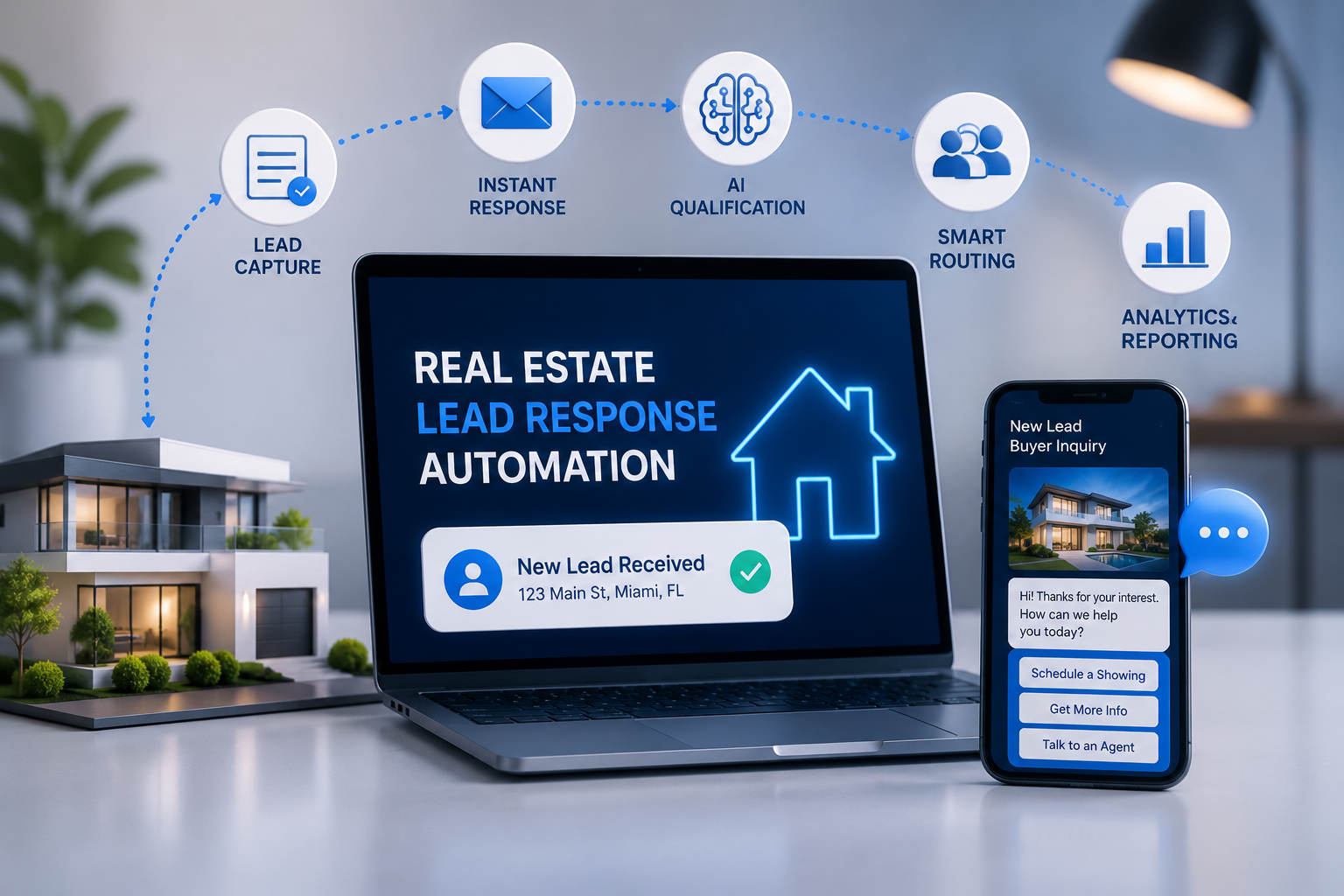
Real estate lead response automation is software that automatically replies to and manages new leads the moment they come in using preset rules and AI so no inquiry sits untouched. Instead of waiting for a human to notice a new lead in the CRM the system sends an instant reply, checks the lead details against your criteria and starts moving them through a workflow built for exactly that type of contact.
Automation for real estate isn’t the same as a basic autoresponder from ten years ago. A basic autoresponder sends one generic message and stops. Real estate lead response automation keeps going. It qualifies the lead, routes it to the right agent and kicks off a nurture sequence that matches whether the person is a buyer, a seller or just browsing.
AI fits into this picture by handling the judgment calls that used to need a human. It can read a message and figure out whether someone wants a viewing this weekend or just wants a price range. It can score how serious a lead is based on their answers. This is where real estate ai stops being a buzzword and starts being the difference between a lead that converts and one that goes cold.
Core Features of a Real Estate AI Assistant
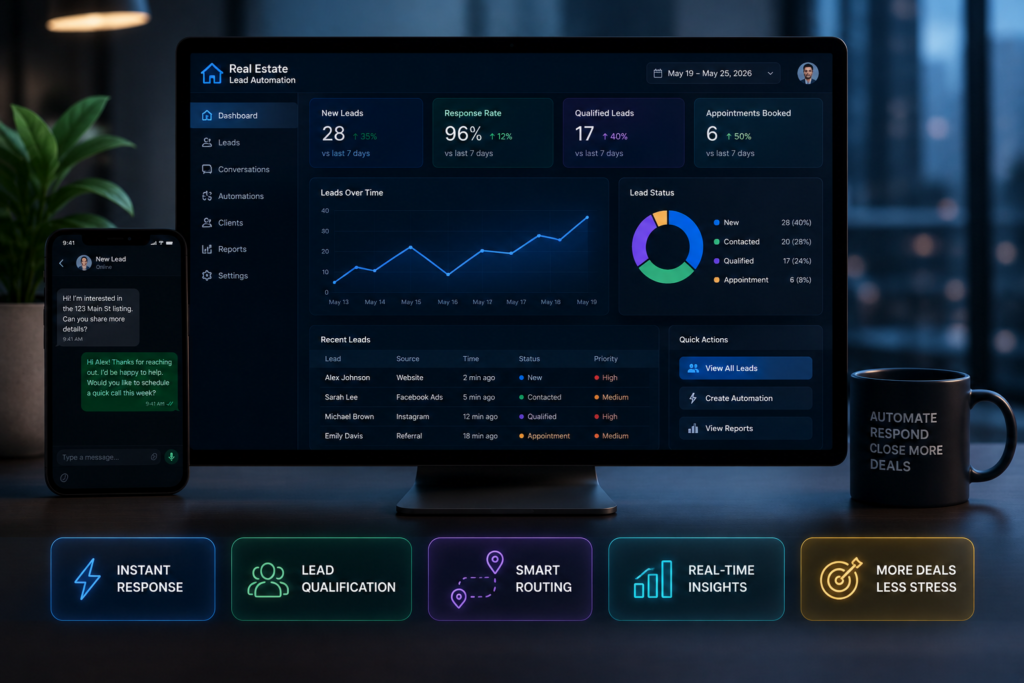
A solid automation platform for real estate agents usually comes with a handful of features working together rather than one single trick.
Instant lead response is the obvious one. The moment a form gets submitted or a call goes to voicemail the system fires off an automated email or an SMS confirming the inquiry was received and offering next steps. Lead scoring runs quietly in the background ranking each new contact by how likely they are to actually buy or sell soon based on behavior and the answers they give.
Lead qualification then filters out the tire kickers from the serious buyers and sellers so agents aren’t wasting calls on people who aren’t ready. Lead routing makes sure a qualified lead gets sent straight to the right agent rather than sitting in a shared inbox where it might get missed. And a dashboard ties it all together so a broker or team lead can see exactly how many leads came in, how fast they got a response and where each one stands.
| Feature | Manual Process | Automated Process |
|---|---|---|
| First reply | Whenever an agent checks email | Within seconds through automated email or SMS |
| Lead scoring | Gut feeling during a phone call | Automatic scoring based on answers and behavior |
| Routing | Passed around a shared inbox | Instantly routed to the right agent |
| Reporting | Spreadsheets updated by hand | Live dashboard |
How to Automate Real Estate Leads Step by Step
The workflow behind this is more straightforward than most agents expect once you see it laid out.
- A lead comes in through lead capture forms on your site, a listing portal or an open house sign in sheet.
- The system sends an instant automated response confirming the inquiry within seconds.
- Crm and automation work together here. Details sync automatically so there’s zero manual data entry.
- Lead qualification runs based on the lead’s answers and behavior and the lead gets routed to the agent who handles that area or price range.
- A drip sequence begins nurturing the lead with relevant listings, market updates and reminders until they’re ready to talk.
If lead generation is the part you’re still figuring out our AI lead generation service pairs well with this because it fills the top of the funnel while automation handles what happens after someone raises their hand.
Real Estate Lead Follow Up System: Nurture Sequences That Build Trust
Not every lead is ready to buy or sell the week they fill out a form. Most aren’t. That’s where a real estate lead follow up system earns its keep because it keeps the conversation going without you having to remember to send a check in message every few days.
A drip sequence built for buyers looks different from one built for sellers. Buyers usually want new listings that match what they searched for and the occasional market snapshot. Sellers respond better to home value updates and stories about what similar homes nearby just sold for. Automated follow-up timing matters too. Space messages too close together and it feels pushy. Space them too far apart and the lead forgets who you are. A reminder sent at the right moment three or four days after silence often does more than five emails sent in the first week.
Automated lead nurturing is really a trust building exercise stretched over weeks or months, and the goal underneath all of it is simple: build relationships that outlast the first inquiry. Real estate sales cycles are long, sometimes six months or longer for a serious buyer working through financing. Nurture leads consistently with an automated nurture sequence and you’re the agent they remember when they’re finally ready. Skip that step and you’re competing from scratch against whoever answers the phone that week.
Instant Response for Real Estate Enquiries: Real World Use Cases
An open house is a great example of where instant response real estate enquiry handling matters most. Someone signs in on a tablet on a Saturday afternoon and if nobody reaches out until Monday the moment is gone. An automated message sent that same evening thanking them for stopping by and asking if they’d like similar listings keeps the door open while the visit is still fresh in their mind.
Listing inquiries work the same way. A buyer messages about a specific address at eleven at night wanting to know if it’s still available. An automated email answering right away, with a note that an agent will follow up in the morning, keeps that potential client from clicking over to a competing listing in the meantime.
After hours enquiries are honestly where this pays off the most because that’s when human response is weakest. A WhatsApp bot handling those late night questions about availability or price can be the difference between a lead that sticks around and one that vanishes. Our WhatsApp automation setup handles exactly this kind of after hours conversation for agencies that get a lot of inquiry traffic outside business hours.
CRM and Marketing Automation Integration for Real Estate Agencies
None of this works well if your CRM and your automation tools aren’t talking to each other. Connecting the two means every new lead, every note from a call and every stage change updates in one place instead of three different spreadsheets that never quite match.
Marketing automation features that real estate agencies actually use tend to be pretty specific. Email marketing sequences for past clients asking for referrals. Automated workflows that flag when a lead hasn’t been contacted in five days. A real estate crm that tags contacts by neighborhood or price range so campaigns can be targeted instead of generic.
Most marketing automation platforms on the market cover the basics fine but real estate businesses usually need the routing and scoring layered on top, which is where a lot of generic marketing automation tools fall short. Agencies with a few dozen agents get the most value here because the automation removes the guesswork about who’s following up with whom. For agencies already running on GoHighLevel our GoHighLevel automation service builds these exact pipelines and funnel pages without starting from a blank template.
Choosing the Right Real Estate Automation Platform
A solo agent and a twenty person real estate team need pretty different things from an automation platform even though the core idea is the same.
A solo agent usually just needs something simple that handles instant response, basic nurture and doesn’t require a technical setup that eats a whole weekend. Real estate teams need routing logic, shared dashboards and permissions so leads don’t get double worked by two agents at once. Before picking ai tools worth asking a few honest questions. Does it integrate with the CRM you already use. Can it handle SMS and WhatsApp, not just email. Does it actually reduce repetitive marketing tasks or just add another dashboard nobody checks.
Real estate processes vary enough between markets that a platform built for high volume rental leads won’t necessarily fit a boutique agency selling luxury homes, and real estate workflows that work in one city can fall flat in another. Worth testing before committing to anything long term.
Results: Faster Lead Response, Higher Conversion, More Closed Deals
Agents who move from manual follow-up to automated response usually see the biggest jump in the first thirty days simply because response time drops from hours to seconds. That alone tends to lift conversion rate more than any script change ever could.
One thing that doesn’t get talked about enough in the real estate industry is that faster lead response times don’t just win more deals, they cut down the number of leads that go completely cold before an agent even makes contact. A basic lead scoring system paired with that faster response is usually what separates the agents who see a real jump in results from the ones who just added another tool without changing anything else.
That’s lead management working quietly in the background rather than a flashy result you’d put in a case study. Combine that with better lead conversion tracking through a dashboard and agents start seeing which lead sources are actually worth the ad spend and which ones are just noise.
How Think AI Works Solves the Lead Follow-Up Problem
Most businesses that come to us aren’t missing leads. They’re missing the system that catches them. A lead comes in through a form, an ad, or a WhatsApp message, and it sits in an inbox until someone has a free minute. By then the moment’s gone.
We build the automated lead follow-up system around wherever your leads actually come from, not just one channel. That means the trigger fires the second a lead enters your CRM, whether that lead started on a landing page, a Meta ad, or a WhatsApp conversation.
Instant Response Without Adding Headcount
You don’t need a bigger sales team to follow up faster. You need the first message to go out automatically, then a person to step in once someone actually replies. That’s the balance we build every workflow around.
One Pipeline, Every Lead Source Connected
If leads come in through five different channels and land in five different places, half of them get missed by default. We pull every source into one pipeline through our GoHighLevel automation setup, so nothing depends on someone remembering to check a second inbox.
Follow-Up That Adapts to Each Lead
Not every lead should get the same sequence. A warm lead ready to book and a cold one that just downloaded a guide need different messages at different speeds. We build the logic so the system tells the difference, using lead scoring to decide who gets a fast direct offer and who goes into a longer nurture track.
Why Choose Think AI Works for Lead Follow-Up Automation
Plenty of agencies will set up a follow-up email and call it automation. We build the full loop, capture, trigger, sequence, and handoff, so nothing depends on a person remembering a step.
What we bring that’s harder to copy is the combination. We’re not just a CRM reseller and we’re not just a chatbot shop. We connect lead capture, WhatsApp and email follow-up, AI-assisted scoring, and CRM workflows into one system, which means fewer handoffs between tools and fewer places for a lead to get lost.
We also don’t hand you a finished automation and disappear. Sequences get reviewed and adjusted based on what’s actually converting, not left running on autopilot from day one. That ongoing part is where most DIY setups fall behind, since a sequence built once in January rarely still fits how leads behave by summer.
Benefits of Working With Think AI Works
The real value isn’t the automation itself, it’s what stops happening once it’s running.
- Leads stop sitting unanswered overnight or over a weekend, since the first message goes out the moment they come in.
- Your sales team spends time on leads that are actually engaged instead of working through a list in order.
- Follow-up stays consistent even during busy weeks, so nothing slips just because someone was slammed with other work.
- Reporting shows which messages in the sequence are actually landing, so the follow-up system gets better over time instead of staying static.
- You get one pipeline instead of leads scattered across email, WhatsApp, and ad platform inboxes.
Each of these ties back to the same problem this article opened with. A lead that goes cold overnight isn’t a sales problem, it’s a system problem, and that’s the part we’re built to fix.
Let’s take the busywork off your plate.
Book a free 30-minute call and we’ll map out exactly where automation can save you hours every week — no pressure, no jargon.
Case Study: Fixing a Broken Follow-Up Process
The problem. A client running lead generation through Meta ads and a website form was losing a noticeable share of leads simply because responses depended on whoever was free that day. Leads that came in after hours or over the weekend often didn’t get a reply until the following business day, by which point several had already gone with a competitor.
The approach. We mapped every point a lead could enter the business, the ad form, the website, and WhatsApp enquiries, into a single CRM pipeline. From there we built an automated follow-up sequence that fired an instant confirmation message, followed by a short value message within a day, and a direct offer if there was still no reply after that.
The solution. Lead scoring was added so replies showing real intent got routed straight to the sales team, while lower intent leads moved into a longer nurture sequence instead of getting dropped entirely. Nothing sat waiting on a person to notice it.
Frequently Asked Questions
u003cstrongu003eWhat is real estate lead response automation?u003c/strongu003e
It’s software that automatically replies to, qualifies and routes new real estate leads the moment they come in instead of waiting for a person to notice and respond manually.
u003cstrongu003eHow fast should a real estate agent respond to a new lead?u003c/strongu003e
Within the first five minutes if possible. Response speed drops off fast after that and most leads have already contacted another agent within the hour.
u003cstrongu003eCan AI automation replace a real estate agent’s follow-up?u003c/strongu003e
No and it isn’t meant to. It handles the instant reply, qualification and early nurture so the agent can step in for the actual conversation once the lead is warm.
u003cstrongu003eWhat’s the difference between a real estate CRM and lead automation software?u003c/strongu003e
A CRM stores contact information and history. Automation software acts on that data by sending replies, scoring leads and moving them through a workflow without someone doing it by hand each time.
u003cstrongu003eHow does automated lead nurturing work for real estate?u003c/strongu003e
It sends a scheduled series of messages, listings and reminders over weeks or months so a lead who isn’t ready yet still hears from you regularly until they are.
u003cstrongu003eWhat is instant response real estate enquiry handling?u003c/strongu003e
It means every inquiry, whether from a listing page, an open house sign in or a late night message, gets an automatic reply within seconds so the lead doesn’t go cold waiting.
u003cstrongu003eDo solo agents need marketing automation or is it only for agencies?u003c/strongu003e
Solo agents often benefit the most because there’s no team to cover for a missed message. A simple automated response can save a deal a solo agent would otherwise lose.
u003cstrongu003eHow does lead scoring work in real estate automation?u003c/strongu003e
The system ranks leads based on their answers and behavior such as how specific their search criteria is or whether they’ve asked about financing giving agents a shortlist of who to call first.
u003cstrongu003eCan automation route leads to the right agent automatically?u003c/strongu003e
Yes. Rules based on location, price range or language can send a lead straight to the agent best suited to handle it instead of a shared inbox nobody owns.
u003cstrongu003eWhat channels can real estate follow-up automation use?u003c/strongu003e
Email, SMS and WhatsApp are the most common. Combining channels usually beats relying on email alone since not everyone checks their inbox quickly.
u003cstrongu003eHow much does real estate marketing automation cost?u003c/strongu003e
It varies widely based on lead volume and how many channels and agents are involved. Simple setups for solo agents cost far less than a multi agent agency workflow with custom routing.
u003cstrongu003eHow do I set up an automated lead follow-up system?u003c/strongu003e
Start by connecting your lead capture forms to your CRM then add an instant response trigger and a basic drip sequence. From there qualification and routing rules can be layered in as volume grows.
Get Started with Real Estate Marketing Automation
Slow follow-up is one of the easiest problems in real estate to fix and one of the most expensive to ignore. Automation in real estate isn’t about replacing agents.
It’s about making sure every lead gets a response before they’ve already moved on to someone else. If you’re ready to see what this looks like for your listings and your team reach out through our contact page and we’ll walk through what a setup built for automation for real estate agents actually looks like for your business.
Sources: Data on lead response time and conversion referenced from published real estate industry research and CRM adoption studies from recognized real estate association and marketing technology research organizations.