Table of Contents
Most sales teams waste hours every week chasing leads that were never going to buy. That is the real cost of manual qualification and it adds up fast when your pipeline grows. Lead qualification automation fixes this by using ai to sort, score and route leads the moment they come in, so your sales team only spends time on people who are actually ready to talk.
This piece walks through how automated lead qualification works, what a good qualification process looks like, how to qualify leads with ai without losing the human touch and which lead qualification software actually earns its price tag. If your business handles a steady flow of new leads through forms, ads or chat, a service like AI lead generation built around automation can save your team from drowning in unqualified contacts.
What Is Lead Qualification Automation
Lead qualification automation is the use of software and ai to evaluate incoming leads against a set of criteria and decide which ones are worth a sales rep’s time. Instead of a person reading every form submission and guessing, the system checks answers, behavior and firmographic data against rules you set once and then it runs on its own.
Here’s the thing most people miss. Automation does not replace qualification, it just removes the guesswork and the delay. A lead qualification bot can ask the same automated lead qualification questions every single time, in the same order, without getting tired on lead number forty of the day. That consistency is where the real value sits.
Qualify leads with ai and you get a score attached to every contact within seconds of them filling out a form or replying to a message. No more sitting in a spreadsheet for three days waiting on someone to review it.
Manual Qualification vs Automated Lead Qualification
Manual qualification means a rep or a junior sales person calls or emails every new lead to ask a handful of questions before deciding if they are worth pursuing. It works fine when you get five leads a week. It falls apart around lead fifty.
The problem with manual lead review is not effort, it is speed and consistency. A high quality lead that comes in at midnight might not get touched until the next afternoon, and by then they have already talked to two competitors. Lead data sitting untouched for even a few hours drops your odds of a real conversation by a wide margin, and most sales teams know this from experience even if they cannot point to the exact study.
Automated lead qualification does the first pass instantly. The new lead answers a few questions or takes an action, the automate rules run, and a score or tag gets applied before your rep has even opened their inbox. Conversion rate tends to climb here, not because the automation closes deals but because reps spend their time on leads based on actual readiness instead of a gut feeling.
How the Automated Lead Qualification Process Works
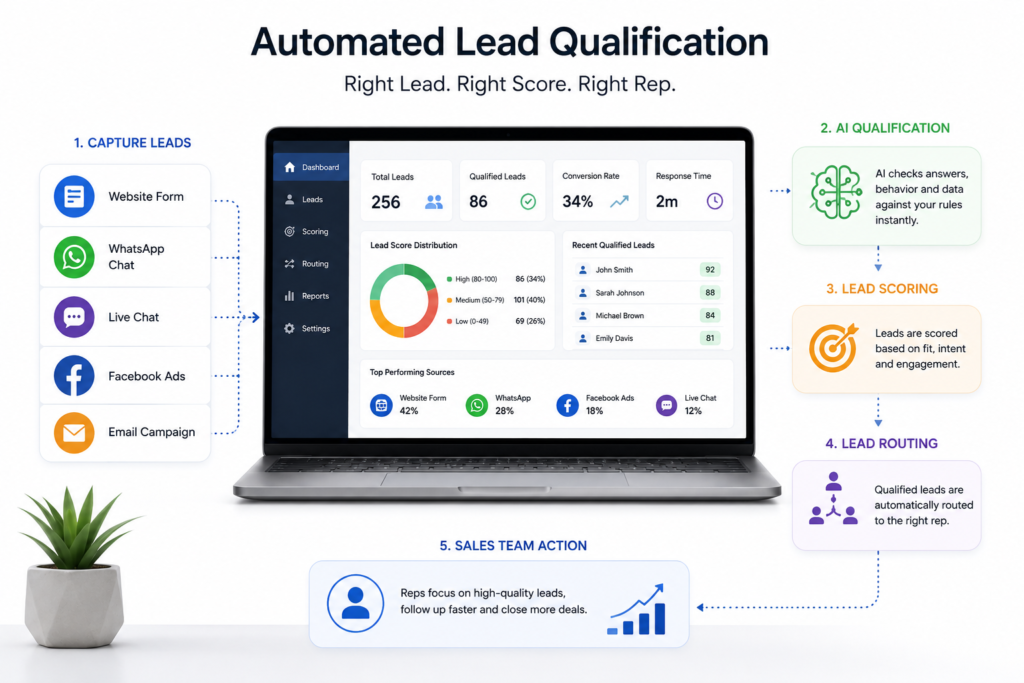
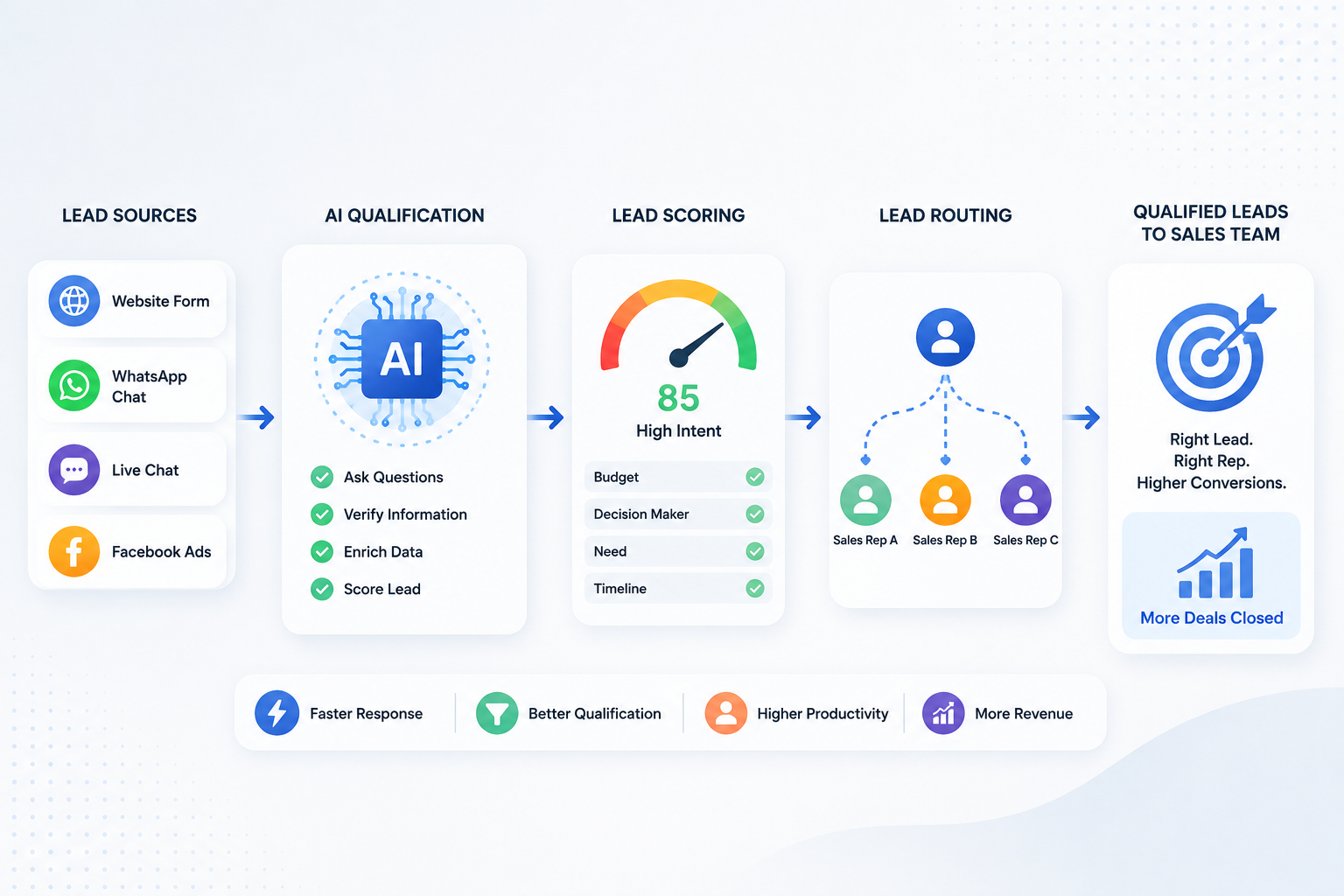
The full qualification flow usually breaks into four stages. It sounds simple written out like this but getting each stage right takes some trial and error.
Lead Capture and Enrichment
Everything starts with lead capture, whether that is a website form, a WhatsApp message, a chatbot conversation or an ad click. Lead enrichment happens right after, where the system pulls in extra details like company size, job title or location from public data sources to round out what the lead gave you directly.
A chatbot handling this on your site or on WhatsApp can grab contact details and qualifying answers in one conversation instead of a clunky multi page form. Tools like WhatsApp automation are built for exactly this, capturing and qualifying leads inside a chat thread people already check every day.
Lead Scoring Model and Predictive Lead Scoring
Once you have the data, the lead scoring model assigns points based on fit and intent. Fit covers things like industry, budget and company size. Intent covers behavior, like how many pages they viewed or how fast they replied to a message.
Predictive lead scoring takes this further by using past deal outcomes to guess how likely a new lead is to close, based on patterns from leads that looked similar before. It is not perfect, and honestly no scoring model ever gets it a hundred percent right, but it beats a rep guessing off instinct alone every time.
Qualification Criteria and Rules
Your qualification criteria are the specific things a lead needs to hit before they get passed to sales. This might be budget above a certain number, a decision making title or a timeline inside the next quarter. Qualification rules turn these criteria into if then logic the software can actually run.
Keep the qualification framework simple at first. A framework with twenty rules sounds thorough but in practice it just slows everything down and confuses whoever has to maintain it later.
Lead Routing and Distribution
Lead routing decides who on your sales team gets the lead once it qualifies, usually based on territory, product interest or rep availability. Lead distribution software can split leads round robin, by account owner or by score tier so nothing sits unclaimed.
Get this step wrong and even a hot lead can sit in the wrong inbox for a day before anyone notices.
BANT Qualification Automation
BANT qualification automation applies the classic Budget Authority Need Timeline framework through software instead of a rep asking each question one by one on a call. The system asks about budget range, checks if the person has decision making authority, confirms there is a real need and asks when they plan to buy, all inside a form or chat flow.
This qualification framework has been around for decades and it still works because it asks the questions that actually matter. What automation adds is speed and the ability to run these qualification workflows at any hour without a human on the other end. A lead qualification framework built on BANT also gives your team a shared language, so when a rep says a lead is BANT qualified everyone knows exactly what that means.
Automated Lead Qualification Questions to Ask Every Lead
Not every lead needs the same depth of questioning but there is a base set that works across most industries.
| Category | Sample Question | What It Tells You |
|---|---|---|
| Budget | What is your rough budget range for this | Whether a lead can actually afford your offer |
| Authority | Are you the one making the final call on this | Lead based decision power |
| Need | What problem are you trying to solve right now | Real intent versus casual browsing |
| Timeline | When are you hoping to have this sorted | Urgency and priority level |
| Fit | How many people or locations does this need to cover | Company size and scale fit |
Every lead does not need all five, but skipping timeline and budget questions is where a lot of qualification efforts fall short. Effective lead qualification usually comes down to asking fewer, sharper questions rather than a long form nobody finishes.
How to Qualify Leads with AI
Qualify leads with ai by letting a chatbot or an ai agent run the conversation instead of a static form. The agent asks questions, reads the answers, applies your qualification rules in real time and tags the lead before handing it to a rep.
Real time qualification matters more than people expect. A lead that gets a reply in under a minute is far more likely to stay engaged than one that waits until morning. An ai agent handling this on your website or through AI chatbot tools can run this every hour of the day, which a small sales team simply cannot match on their own.
Lead qualification ai is not just chat based either. Ai scoring can run quietly in the background on form submissions, ranking leads by likely value without the person ever knowing a bot touched their data. It is one of the areas where uses ai genuinely saves a team from busywork rather than just adding another dashboard to check.
Lead Qualification Bot vs Traditional CRM Qualification
A crm on its own is mostly a record keeper. It stores lead data and lets a rep add notes, but most standard crm setups do not qualify anything automatically unless you build the logic in yourself.
A lead qualification bot sits in front of that crm and does the actual work of asking questions and applying scores before the lead ever gets logged. A lead qualification system built this way means your reps open their crm and only see leads that already passed the bar, instead of a long list they have to sort through manually.
This does not mean the crm becomes useless. It still matters for tracking the full lead management picture, follow up history and pipeline stage. The bot just handles the front door work so your team is not doing it by hand.
Best Lead Qualification Software Features to Look For
Picking the right tool matters more than people think, and there is no single best lead qualification software that fits every business. Here is what actually separates the good options from the ones that look fancy in a demo but fall flat in daily use.
| Feature | Why It Matters |
|---|---|
| Custom qualification criteria | Every business qualifies differently, rigid templates rarely fit |
| Lead scoring software built in | Saves you from bolting on a second tool just for scoring |
| Crm integration | Right lead qualification software should sync data both ways without manual exports |
| Ai tools for scoring and routing | Speeds up decisions without adding headcount |
| Reporting on lead volume and conversion | You need to see what is actually working over time |
Top lead qualification platforms usually combine a form or chat builder with scoring logic and routing in one place, rather than forcing you to stitch three separate tools together. A GoHighLevel automation setup is a good example of this, since it handles capture, scoring and routing inside one pipeline instead of scattering the qualification flow across different apps.
Lead Scoring and Routing at Scale
Qualification at scale looks different than qualifying ten leads a week. When lead volume climbs into the hundreds, small inconsistencies in your rules start showing up as real revenue loss.
Lead scoring and routing at this size needs to run without a human checking every single record. Qualification and scheduling can even connect directly, so a lead that hits a high score gets booked straight onto a rep’s calendar without anyone lifting a finger. Automated lead qualification and routing working together like this is what actually lets a lean sales team handle a lead volume that would otherwise need three more hires.
Lead prioritization becomes the deciding factor here too. Modern lead systems do not just qualify yes or no, they rank leads so reps know exactly which ten to call first out of the fifty that came in overnight.
Benefits: Why Automate Lead Qualification
The biggest win is speed, but it is not the only one. Conversion rate improves because reps are working leads based on actual signals instead of a first come first served list. Lead conversion rates in businesses that automate this step tend to run higher simply because the right people get contacted first.
Marketing automation and qualification automation work well together too. When your marketing automation platform hands off a high quality lead the moment it hits a score threshold, there is no lag between interest and outreach. Lead management gets simpler overall because your team stops manually shuffling contacts between spreadsheets and the crm.
It is worth being honest here. Automation is not free of trade offs. A poorly built qualification framework can reject good leads just as fast as it filters bad ones, so your lead qualification efforts need review every few months, not a set it and forget it approach.
How Think AI Works Solves the Lead Follow-Up Problem
Most businesses that come to us aren’t missing leads. They’re missing the system that catches them. A lead comes in through a form, an ad, or a WhatsApp message, and it sits in an inbox until someone has a free minute. By then the moment’s gone.
We build the automated lead follow-up system around wherever your leads actually come from, not just one channel. That means the trigger fires the second a lead enters your CRM, whether that lead started on a landing page, a Meta ad, or a WhatsApp conversation.
Instant Response Without Adding Headcount
You don’t need a bigger sales team to follow up faster. You need the first message to go out automatically, then a person to step in once someone actually replies. That’s the balance we build every workflow around.
One Pipeline, Every Lead Source Connected
If leads come in through five different channels and land in five different places, half of them get missed by default. We pull every source into one pipeline through our GoHighLevel automation setup, so nothing depends on someone remembering to check a second inbox.
Follow-Up That Adapts to Each Lead
Not every lead should get the same sequence. A warm lead ready to book and a cold one that just downloaded a guide need different messages at different speeds. We build the logic so the system tells the difference, using lead scoring to decide who gets a fast direct offer and who goes into a longer nurture track.
Why Choose Think AI Works for Lead Follow-Up Automation
Plenty of agencies will set up a follow-up email and call it automation. We build the full loop, capture, trigger, sequence, and handoff, so nothing depends on a person remembering a step.
What we bring that’s harder to copy is the combination. We’re not just a CRM reseller and we’re not just a chatbot shop. We connect lead capture, WhatsApp and email follow-up, AI-assisted scoring, and CRM workflows into one system, which means fewer handoffs between tools and fewer places for a lead to get lost.
We also don’t hand you a finished automation and disappear. Sequences get reviewed and adjusted based on what’s actually converting, not left running on autopilot from day one. That ongoing part is where most DIY setups fall behind, since a sequence built once in January rarely still fits how leads behave by summer.
Benefits of Working With Think AI Works
The real value isn’t the automation itself, it’s what stops happening once it’s running.
- Leads stop sitting unanswered overnight or over a weekend, since the first message goes out the moment they come in.
- Your sales team spends time on leads that are actually engaged instead of working through a list in order.
- Follow-up stays consistent even during busy weeks, so nothing slips just because someone was slammed with other work.
- Reporting shows which messages in the sequence are actually landing, so the follow-up system gets better over time instead of staying static.
- You get one pipeline instead of leads scattered across email, WhatsApp, and ad platform inboxes.
Each of these ties back to the same problem this article opened with. A lead that goes cold overnight isn’t a sales problem, it’s a system problem, and that’s the part we’re built to fix.
Case Study: Fixing a Broken Follow-Up Process
The problem. A client running lead generation through Meta ads and a website form was losing a noticeable share of leads simply because responses depended on whoever was free that day. Leads that came in after hours or over the weekend often didn’t get a reply until the following business day, by which point several had already gone with a competitor.
The approach. We mapped every point a lead could enter the business, the ad form, the website, and WhatsApp enquiries, into a single CRM pipeline. From there we built an automated follow-up sequence that fired an instant confirmation message, followed by a short value message within a day, and a direct offer if there was still no reply after that.
The solution. Lead scoring was added so replies showing real intent got routed straight to the sales team, while lower intent leads moved into a longer nurture sequence instead of getting dropped entirely. Nothing sat waiting on a person to notice it.
Let’s take the busywork off your plate.
Book a free 30-minute call and we’ll map out exactly where automation can save you hours every week — no pressure, no jargon.
Choosing the Right Lead Qualification Software for Your Sales Team
Start simple. Pick a tool that lets you qualify a lead with a short, clear set of questions before you add complexity. A simple lead qualification setup with five or six good questions will outperform a bloated twenty field form every time.
Lead nurturing should connect to whatever you pick too, since not every lead that fails qualification today is dead forever. Some just are not ready yet, and lead behavior over the following weeks can tell you when to try again. Watching lead response over time is often more useful than the initial score alone.
If your team is still qualifying leads by hand or your current setup feels like a bottleneck, working with a team that builds these systems for a living saves months of trial and error. LinkedIn automation paired with a proper qualification flow on the inbound side can cover both outbound and inbound qualification without needing two separate systems.
Frequently Asked Questions
u003cstrongu003eWhat is lead qualification automation?u003c/strongu003e
Lead qualification automation is the use of software and ai to score, filter and route incoming leads without a person manually reviewing each one. It applies your qualification criteria the moment a lead comes in.
u003cstrongu003eHow do you automate lead qualification?u003c/strongu003e
You set up qualification rules based on budget, authority, need and timeline, then connect a form, chatbot or ai agent to apply those rules automatically. The system scores each lead and routes it based on the result.
u003cstrongu003eWhat are automated lead qualification questions?u003c/strongu003e
These are the standard questions a bot or form asks every new lead, usually covering budget, decision making authority, the problem they need solved and their timeline. They are the same questions a rep would ask on a call, just automated.
u003cstrongu003eHow does ai qualify leads?u003c/strongu003e
Ai reads the answers a lead gives, checks behavior signals like page visits or reply speed, and applies a scoring model to rank how likely that lead is to convert. It does this in real time instead of a rep reviewing it hours later.
u003cstrongu003eWhat is a lead qualification bot?u003c/strongu003e
A lead qualification bot is a chat based tool that asks qualifying questions directly to a lead, usually on a website or through WhatsApp, and scores the answers before handing the contact to sales.
u003cstrongu003eWhat is BANT qualification automation?u003c/strongu003e
It is the Budget Authority Need Timeline framework run through software instead of a manual call. The system checks all four factors and flags leads that meet your bar automatically.
u003cstrongu003eWhat is the best lead qualification software in 2026?u003c/strongu003e
There is no single answer since it depends on your lead volume and sales process, but the strongest options combine scoring, crm sync and routing in one platform rather than requiring separate tools stitched together.
u003cstrongu003eHow is lead scoring different from lead qualification?u003c/strongu003e
Lead scoring assigns a number based on fit and intent signals. Lead qualification is the process of deciding, based partly on that score, whether a lead moves forward to sales at all.
u003cstrongu003eWhat qualification criteria matter most?u003c/strongu003e
Budget and timeline tend to matter most because they tell you if a lead can buy and when. Authority matters too, since talking to someone without buying power wastes time on both sides.
u003cstrongu003eHow does lead routing work after qualification?u003c/strongu003e
Once a lead qualifies, routing rules send it to a specific rep based on territory, product line or availability. Distribution can be round robin or weighted toward whoever has capacity that day.
u003cstrongu003eCan small sales teams automate lead qualification?u003c/strongu003e
Yes, and honestly small teams often benefit the most since they cannot afford to waste hours on leads that were never going to close. A simple automated setup can do the work of an extra junior hire.
u003cstrongu003eWhat is the difference between manual and automated qualification?u003c/strongu003e
Manual qualification relies on a person reviewing each lead by hand, which is slow and inconsistent. Automated qualification applies the same rules instantly to every lead, day or night.
u003cstrongu003eHow much does lead qualification software cost?u003c/strongu003e
Pricing varies widely based on lead volume and features, from a few hundred dollars a month for smaller setups to much higher for enterprise platforms with advanced scoring and routing.
u003cstrongu003eDoes automation hurt lead quality?u003c/strongu003e
Not if the qualification rules are built well. A poorly designed framework can filter out good leads, so rules need periodic review rather than being left untouched for years.
u003cstrongu003eHow does lead qualification integrate with a crm?u003c/strongu003e
Most modern qualification tools sync directly with a crm, pushing scored and tagged leads in automatically so reps see a ready to work list instead of raw form submissions.